


Episode #76 is about exploring love through maintenance and the disruptive, delightful, mundane, difficulty of the everyday.
Jérôme Denis is Director of the Centre de sociologie de l’innovation at Mines Paris-PSL. David Pontille is Director of Research at Centre national de la recherche scientifique (CNRS) in Paris. Their book is The Care of Things: Ethics and Politics of Maintenance. They work in Science and Technology Studies.
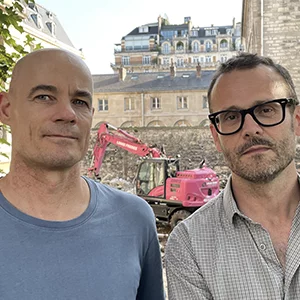
Welcome to Love and Philosophy, where we explore philosophical, scientific, and technological spaces beyond either/or bounds. This episode is a conversation about care, maintenance, and our relationship with the material world. Philosopher Andrea Hiott introduces this discussion about the often-overlooked topic of maintenance and its philosophical, scientific, and emotional significance. She gives listeners an intro to the interdisciplinary field of Science and Technology Studies (STS) and highlights the contributions of influential figures like Bruno Latour, so listeners have some background for the rich discussion as the guests discuss their book ‘The Care of Things,’ which emerged from their unexpected findings while investigating the Paris Metro signage system. They explore how maintenance and care reveal the fragility, multisensory engagement, and relationality of objects and how even mundane tasks hold deep significance. The three underline the interconnectedness of people and objects, challenging the notion of autonomous entities and underscoring the often hidden yet crucial work of maintenance.
As the book tells us from the beginning: People don’t just live among objects, they take care of them. From coffee machines to cathedrals, satellites to washing machines, smartphones to bridges, nothing survives without ongoing care. But we rarely give this care the recognition it deserves.
The discussion extends to the personal experiences of the authors, their approach to teaching, and the emotional resonance of caring for things, ultimately advocating for a greater appreciation of everyday maintenance and its broader implications in contemporary society.
The Care of Things began, as many important projects often do, by accident. Jérôme Denis and David Pontille didn’t set out to study maintenance. They were investigating something they thought they understood, the signage system of the Paris Metro that guide millions of travelers daily. They wanted to understand “the power of writing, its capacity to concretely organize our ways of living together.” But near the end of a two-year investigation, someone casually asked: “Have you talked to the maintenance workers?”
And it turned out to be a question that changed everything.
“The signs, which we thought we knew in every detail were literally transformed before our eyes.” What they had seen as solid, immutable, standardized objects revealed themselves as fragile, constantly transforming entities held in place by invisible labor. The maintenance workers were experts at what the philosopher Gilles Deleuze called “plugging into the flux of matter”, but this wasn’t abstract philosophy. It was concrete, embodied, everyday work. Not so romantic, and yet important as any form of love.
What emerged from this encounter is a book that asks us to fundamentally rethink how we live with objects, with each other, and with the world. It’s a topic that fits well with Science and Technology Studies (STS), an interdisciplinary field that examines how science and technology are inseparable from social, political, and economic life.
Rather than treating scientific facts as objective truths discovered in isolation, STS scholars investigate how knowledge is actually produced through networks of humans, institutions, materials, and practices.
One of the field’s most influential figures was Bruno Latour (1947-2022), a French philosopher, anthropologist, and sociologist whose groundbreaking books and his work with others (Michel Callon, Madeleine Akrich, John Law, etc.) towards Action Network Theory (ANT) helped establish STS as a field. His books have grown increasingly more influential over the years, including Laboratory Life (1979), Science in Action (1987), and We Have Never Been Modern (1991).
Latour challenges readers and students to stop separating humans from nonhumans, arguing that objects are not passive things but active participants in social networks. ANT traces how associations between people and things create the stable patterns we call society.
A key idea here is one you will recognize from many of our other conversations, though this one comes from an STS angle, and that is that idea that everything in the social and natural worlds exists in constantly shifting networks of relationships.
In his famous essay “Where Are the Missing Masses?” Latour made a provocative argument towards that idea: when sociologists tried to understand social bonds, they consistently came up short and felt that something was missing. That something was the relation of and with the material artifacts that surround us—from doorknobs to seat belts, for these are not mere tools but moral agents that shape our behavior, delegate responsibilities, and hold society together in some very literal ways we have the luxury not to notice most days. But all those everyday ongoing relations are attended to by someone, and that’s where maintenance comes into play.
In contrast to this reality of maintenance, we often think about repair, which is dramatic, heroic, event-based. Something breaks and someone fixes it; order is restored.
We notice repair. It’ the plot line for all our blockbuster movies, whereby someone saves the day.
Maintenance is something else, more like the daily pulsation of care that prevents breakdown before it happens.
It’s repetitive, ongoing, mostly unnoticed. “When there is an emergency and things have to be repaired, we notice,” but real love and real life are matters of everyday ongoing maintenance.
As David explains, maintenance’s drama is to “make everything go on as if nothing had happened.” But to whom does nothing happen? As soon as you follow maintenance workers, you discover that so much is happening, too much to hold, so much that it takes someone’s constant vigilance, bodily engagement, multisensory expertise, decisions about intervention, negotiations with materials. This ‘nothing’ is actually quite an achievement and a sort of ongoing societal work that becomes invisible precisely because it succeeds.
Still, the book doesn’t romanticize maintenance.
Care can be exhausting, overwhelming, even harmful. Maintenance workers can be injured by the tools and materials they use. Some French Ford Mustang owners (discussed in the book and in this conversation) sometimes become so overwhelmed by the constant vigilance required that they sell their cars. You can care so much for something that you destroy it—or yourself.
As David says clearly: “We are not ‘for’ maintenance.” They’re not arguing that we should maintain everything forever. Rather, they’re asking us to notice maintenance, to recognize the work it requires, to understand the interdependencies it reveals. Sometimes the right decision is to let things go, to stop maintaining. But that should be a conscious choice, not a default driven by the illusion of autonomy.
The late-night comedian John Oliver captured this perfectly in a 2015 episode about infrastructure.
His team created a movie trailer about bridge maintenance—famous actors adjusting screws, checking for leaks, tightening bolts, all set to suspenseful music. It’s absurd and hilarious precisely because it reveals the truth: maintenance is profoundly important yet spectacularly undramatic. We would rather watch a bridge explode and be heroically rebuilt than watch it be quietly, carefully, lovingly maintained. To get a feel of it, watch John Oliver and his skit about Infrastructure.
Jérôme and David’s work moves deeper or farther than repair and than what we’ve already said above regarding ANT and Latour. That work mainly focused on how objects resist, how they push back, how they stabilize. This book shows us the fragility, transformation, and ongoing work required to maintain the appearance of stability is actually where the potency is at. Even Latour gradually turned his attention away from mundane maintenance, focusing instead on innovation and the negative effects of material entities on our world.
Artists like Mierle Laderman Ukeles, one of the main threads in the book, brought it back. Mierle Laderman Ukeles (1939) is a New York City-based artist known for her feminist and service-oriented artwork and the attention it gives to maintenance. She has been the Artist in Residence (unpaid) of the New York City Department of Sanitation since 1977.
What maintenance workers revealed to Jérôme and David was something more subtle and profound: maintenance doesn’t just respond to fragility—it produces the very solidity we take for granted. The immutable becomes so through care. The stable becomes so through attention.
Fragility as Foundational Strength
The book argues that fragility (rather than only robustness or autonomy, which are not the opposite) is the foundation of our relationships with objects and each other, and Andrea reads this as a kind of strength and dynamic power that we rarely notice as such and try to hide.
Drawing on feminist care ethics, particularly the work of Annemarie Mol and María Puig de la Bellacasa, they show that the logic of care takes as its starting point our physical embodiment and the fragility of life.
Care is fundamentally about interdependencies, not independence.
It acknowledges that all things—including ourselves—require ongoing support to persist. Vulnerability and the need for care are not weaknesses, and those who receive care (whether people or things) are not passive. Rather, care is an active, dynamic relationship that creates the conditions for life to continue.
Multi-sensory and Embodied: two themes of L&P and CofT
When Jérôme and David followed maintenance workers through the Paris Metro, they discovered a form of expertise that engages all the senses. These workers don’t just look at signs; they touch surfaces to feel degradation, they listen for sounds that indicate problems, they smell for chemical changes, they notice vibrations and patterns invisible to untrained observers.
This same idea comes through the stories of classic Mustang owners in Europe. These aren’t wealthy collectors that keep these cars in museums; they’re everyday folks who have saved for years to own these cars. And they drive them daily. In so doing, they’re plugged into their cars bodily: feeling vibrations through the seat, hearing sounds through the steering wheel, noticing the slightest change in engine rhythm.
They live in what Jérôme calls a “disquieting attention” whereby they are constantly attuned to fragility, worried but also deeply connected. When they need to replace a part, they consult the entire community: “If I change this, is it still a classic Mustang?” Their care is what keeps the car authentic, even as (or especially as) everything transforms in the daily grind of life. And by studying their care for their cars, some new understanding emerges.
This leads towards what cultural theorist Yves Citton discusses as a sort of meta-attentional engagement, of paying attention to how we pay attention, thinking of this as an ecology.
This reassignment of attention—from innovation and crisis to the everyday, is one way into understanding a profound political and ethical shift. At what cost does a thing remain the same? At what human cost? At what environmental cost? A bridge, a nuclear plant, even the Mona Lisa— none of these last on their own. They require people to maintain them.
Jérôme and David draw explicitly on feminist theories of care to argue that maintenance is skilled, demanding, valuable work that our economic and social systems systematically undervalue. Just as feminist theorists revealed how domestic labor is rendered invisible and unpaid, just as they showed how the myth of the autonomous individual obscures our fundamental interdependence, this book reveals how the myth of autonomous technology obscures the human labor required to sustain it.
We tend to think AI is going to solve everything, but who is going to care for those systems and technologies? And what good are they if we lose the care of the everyday?
When you look at architectural magazines, you never see maintenance workers. When you see advertisements for infrastructure, you see sleek objects rather than the people who clean them, repair them, monitor them. This erasure says a lot about whose work counts, whose expertise matters, who deserves recognition and compensation.
Mierle Laderman Ukeles, Making Maintenance Visible
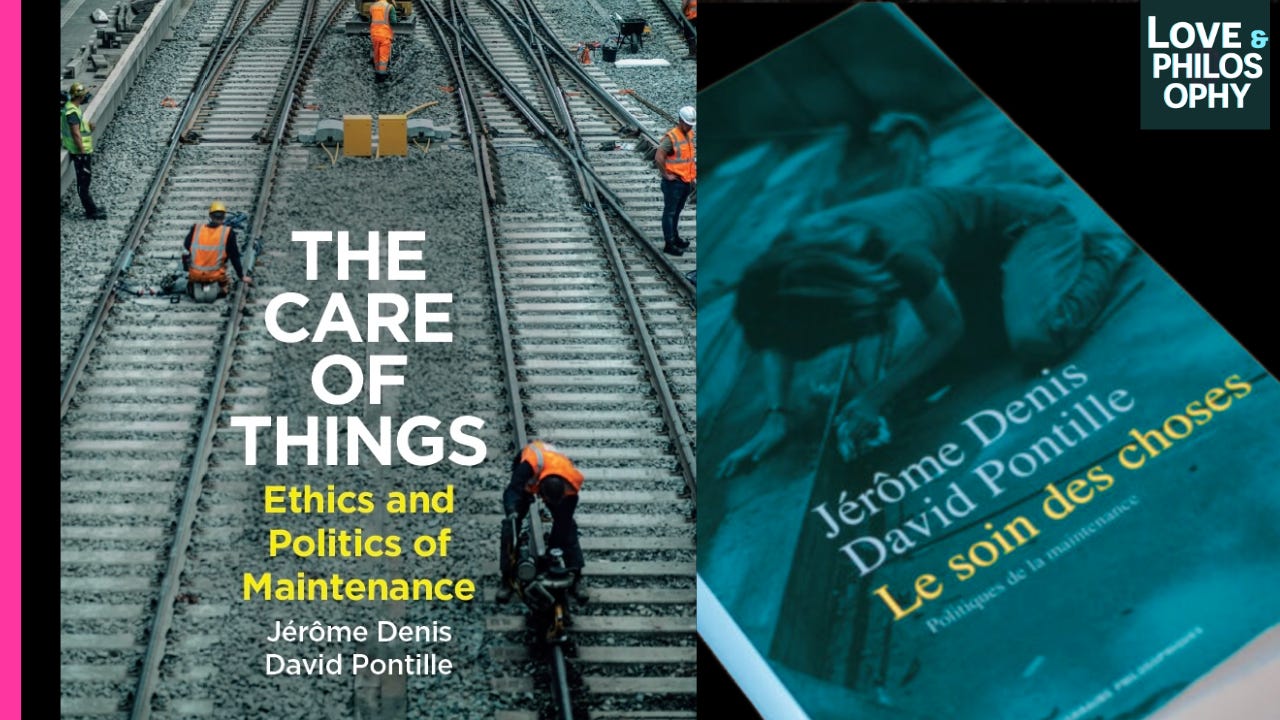
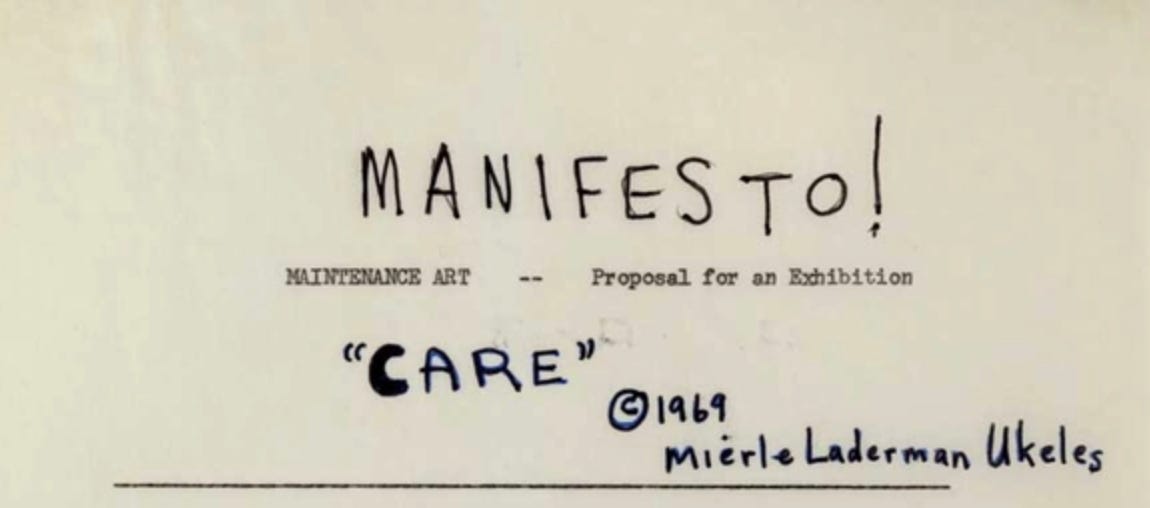
Running through the book, and literally appearing on the cover of the French edition, is the work of the artist mentioned earlier, Mierle Laderman Ukeles (b. 1939), a pioneering American artist who in 1969 wrote her “Manifesto for Maintenance Art 1969! Proposal for an Exhibition: ‘CARE.’”
Ukeles’s manifesto emerged from a personal and political crisis. As a young artist and new mother, she found herself overwhelmed by housework and childcare, with little time for what she thought of as her “real” art. A male professor at Pratt had even told her that becoming a mother meant she could no longer pursue an art career. Her response was to realize and then designate her maintenance work as art itself.
“I am an artist. I am a woman. I am a wife. I am a mother. (Random order). I do a hell of a lot of washing, cleaning, cooking, renewing, supporting, preserving, etc. Also, (up to now separately) I ‘do’ Art. Now I will simply do these everyday things, and flush them up to consciousness, exhibit them, as Art.”
(Ukeles, Manifesto for Maintenance Art, 1969).
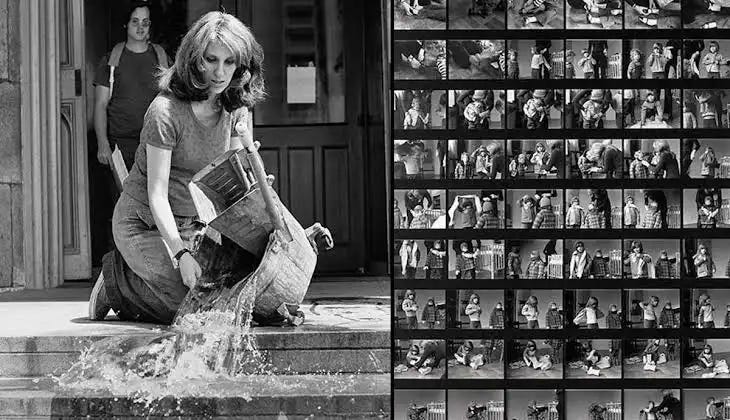
In 1973, in an iconic set of photographs, Ukeles scrubbed the steps and floors of the Wadsworth Atheneum museum during opening hours, wielding her mop like a paintbrush. In 1977, she became the first (and still only as far as we can tell) artist-in-residence at the New York City Department of Sanitation, an unsalaried position she has now held for nearly five decades. Her masterwork Touch Sanitation (1979-80) (what a title!) involved shaking hands with all 8,500 New York City sanitation workers, telling each one: “Thank you for keeping New York City alive.”
Ukeles revealed that the opposition between “development” (innovation, creation, the making of new things) and “maintenance” (preservation, repetition, the sustaining of existing things) is gendered, classed, and profoundly political. Maintenance is not inferior to creation but it is the condition of all creation, all life, a lot like love.
Carelessness as Comfort
One of the most provocative arguments in the book concerns what Jérôme calls the “configuration of carelessness as comfort.” In the conversation, he describes a moment of realization: “I knew that, but I really realized how much in 50 years, and even less, a whole kind of model of consumption had been installed by a certain kind of capitalism, where hyper-consumption has replaced everything.”
He traces how expertise in caring for things was once ubiquitous, how not too long ago ”we were all experts” and how that has been systematically dismantled. Modern comfort was designed with carelessness built in. As one podcaster’s father told her when asked why he never taught her to maintain things: “We wanted you to enjoy life.” The implication being that caring for things is a burden to be escaped rather than a relationship to be cultivated.
David shares how this research reconnected him to his grandparents and family life in a new way, and helped him reimagine what it meant that everything must last: “When you are a small kid and you are always on your knees and never on your feet... they’d say ‘think of your pants!’” For a long time he dismissed this as “a generational thing.” But working on maintenance made him realize: “It’s really connected to climate change and everything today.”
Maybe it sounds like nostalgia for a pre-modern past but it is actually a recognition that the ability to notice fragility, to care for things, and to make them last are skills and sensibilities that have been deliberately eroded. And their erosion has consequences not just for objects but for how we relate to each other, to our environments, to life itself.
By the end of this conversation (and book), we see how this has really changed everyday lives in everyday ways, and how powerful this is, as real care.
David describes how this work has transformed his approach to supervising PhD students. Instead of just “trying to explain how to do a good PhD,” he now takes time to “understand who they are, what they try to do with this topic, how the topic relates to their own experience.” Some of his former students have become close friends because of this deeper attention to care.
“It’s like two people going on the same road for a time.”
Jérôme talks about teaching engineers and future leaders who will make decisions about infrastructure, technology, society. His goal is to “debunk the idea of autonomy in technology” and help them see that “each time you say that a technology is autonomous, you are leaving a lot of people aside.” He points to AI and the invisible labor of annotators. He challenges them to ask: Who is this supposed autonomy really serving?
Both describe how they can no longer navigate the city the same way and how people often have that same reaction after reading the book. Jérôme talks about the graffiti removal workers who “really love Paris” and care for its stone facades with what can only be called an act of love. David talks about seeing every object as a network, a flow, a web of interdependencies rather than a stable, autonomous thing.
The book’s “very modest but also very ambitious aim,” Jérôme says, is “for each reader to end it and not look at the world exactly the same way.” This is what he calls a “percept” which is not just a concept to understand but a new way of perceiving, a transformation of sensibility.
So what does all this have to do with love? A lot, if we understand love as a form of attention, a way of being in relationship, a practice of care that acknowledges fragility and interdependence or even what is holding us, whether we like it or notice it or not.
Love recognizes that autonomy is a myth and that we are all, always, held by networks of care that mostly go unnoticed precisely because they work.
Steven Jackson says: “If we could love our artifacts and the things we are living with, maybe a lot of things would change in the world.” Jérôme acknowledges it’s “a bit romantic” but insists it’s important. The graffiti removal workers love Paris. The Mustang owners love their cars. The Metro maintenance workers love their signs—or at least they care for them with a fidelity and attention that looks a lot like love.
This kind of love is not sentimental. It’s sensory, embodied, sometimes exhausting. It involves touching rust and smelling chemicals and feeling vibrations and being careful. It requires noticing what others miss. It means accepting that nothing lasts without work, that autonomy is always an illusion sustained by someone else’s labor.
As Jérôme says beautifully at the end of the conversation: maintenance workers “taught us to pay attention to the attention of others.” This meta-attentional practice (noticing how others notice, caring about how others care) is fundamentally an ethical and political stance. It means repopulating our picture of the world with all the people whose work makes our lives possible.
Reimagining care through our relationships with objects might help us reimagine care in other ways, care for each other, care for life itself, care for our ecosystems, care for our own embodied existence. Not because objects and people are the same, but because both are fragile, both require ongoing attention, both exist in ecologies of interdependence that our culture systematically obscures.
This is not about rejecting innovation or development. It’s about balance, about recognition, about making visible the work that goes unnoticed. It’s about understanding that the daily pulsation of maintenance is not background noise but the heartbeat of life itself.
As Jérôme and David conclude: the future doesn’t lie in making things unbreakable or autonomous, but in learning to care for fragility—in objects, in each other, in ourselves.
Jérôme Denis is Professor of Sociology and Director of the Centre de Sociologie de l’Innovation at Mines Paris-PSL, one of France’s elite engineering schools. His research focuses on two interconnected domains: data work and maintenance practices. Through extensive ethnographic investigations in companies, public administrations, and urban environments, Denis explores how both data and infrastructure require constant care to function.
David Pontille is Director of Research at CNRS (the French National Center for Scientific Research) and a senior researcher at the same Center. His research sits at the intersection of science and technology studies, anthropology of writing, and ethnography of work. His work spans writing practices in professional settings, the evaluation technologies of scientific research, and the politics of maintenance in technological infrastructures. He is a founding member of the Revue d’Anthropologie des Connaissances.
The collaboration between Jérome and David began in the late 1990s as young PhD students on the same team, a model of slow, patient, collaborative scholarship that, fittingly, embodies the very ethic of maintenance it describes.
Read the book. Available in all major outlets.
This article and podcast is informational only and not meant as professional guidance or advice

(French cover of book image is from this blog post which we recommend reading.)


