


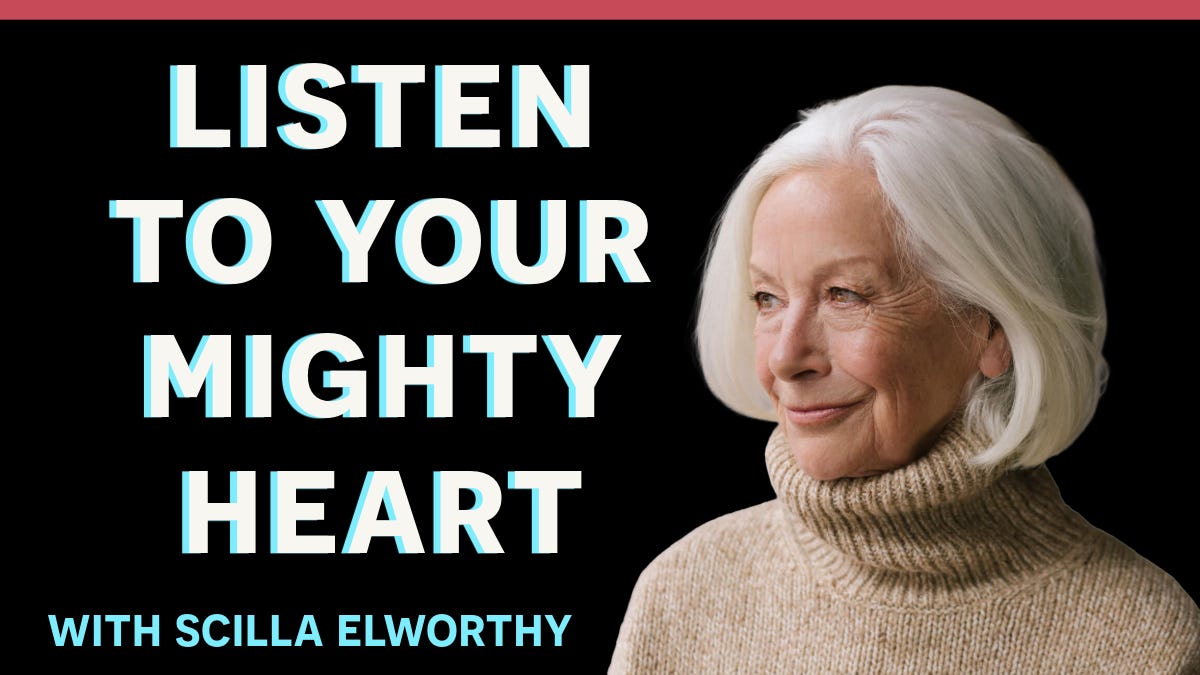
Three-time Nobel Peace Prize nominee (Oxford Research Group) Scilla Elworthy reflects on 70 years of work with conflict and war, beginning at age 12 after seeing tanks in Budapest, then being sent to help concentration camp survivors. For her, the lesson of a lifetime, the one she feels is urgent right now, centers on “the vital importance of the heart for all we’re trying to address and change in today’s world.” It might seem too intimate or uncomfortable (at least for some of us) to talk about love and the heart so openly, but if we can sit with that difficulty, we may find power opening beyond the threshold.
Scilla describes how the suffering of others suffering hit her heart and led her to action in Algeria, the Congo, and South Africa, where she worked on starvation relief, shipped milk powder, supported education, and generally tried to find a way to deal with her own inner bully. She notes the central role of women in community resilience and her mother’s role in her own life. She emphasizes “listening with the heart” to discern what people truly need beyond narratives, and explains how turning to the heart helps release harsh self-criticism. She also shares practical self-nourishment through nature and gardening, and recounts how humanizing, vulnerable moments can soften high-stakes meetings, including military dialogues in China, as a way to build connection and “power with” others.
“Triple nominated for the Nobel Peace Prize for her work with Oxford Research Group to develop effective dialogue between nuclear weapons policy-makers worldwide and their critics from 1983-2003. Founded Peace Direct in 2002, awarded the Niwano Peace Prize in 2003, the Luxembourg Peace Prize in 2020, the GOI Peace Award in 2023. Founded The Business Plan for Peace based on her latest books - The Business Plan for Peace: Building a World Without War (2017), The Mighty Heart: how to transform conflict (2020), and The Mighty Heart in Action (2022).”
Dr Scilla Elworthy is:
Founder of The Mighty Heart
Founder of Peace Direct
Founder of Oxford Research Group
Watch her
TED Talk: Fighting with Non-violence
and here is the Kyla Scanlon post briefly mentioned here
Join Andrea at a live event in NYC here with Sophie Fiennes in April for her amazing film Acting which is about the work of Cheek by Jowl & Shakespeare.
00:00 Why We Still Kill
00:55 Action Over Apathy
01:07 Heart As Guide
01:39 Inner Critic Quieted
03:23 Podcast Introduction
07:03 Meet Scilla Elworthy
08:17 Tanks In Budapest
11:32 Early War Witnessing
14:33 Africa Conflict Journeys
17:47 Women Leading Change
19:52 Listening With Heart
22:29 Defining The Heart
25:31 Nature As Nourishment
29:35 Self Inspection To Embodiment
32:41 Taming The Inner Critic
34:04 Heart Led Self Compassion
35:54 Daring Diplomacy With Generals
36:49 Breaking The Ice With Humanness
42:48 Power With Vulnerability
47:24 Courage In The Moment
51:07 Love In The Garden
53:03 Closing Thanks And Future Fears
53:55 Listener Note And NYC Event
Recent:


YouTube, Facebook, Instagram, Substack.
And as Andrea says at the end of this episode, a big thank you to Mark McCartney for making this conversation happen. If you have not yet listened to What is a Good Life by Mark, do sign up right away here.
Love & Philosophy is built on the belief that care is our most primary orientation and that philosophy (at its best) is not a subject but a practice, something accumulated slowly in a body, across a lifetime of paying attention.
Read the full TRANSCRIPT HERE at this link. Everything below is extra.
Here are some extra written questions that Andrea and Scilla exchanged via email. None of this below is part of the interview but you can find the interview and full transcript here.
Andrea: You’ve described peace as beginning with the self, listening inward before you can truly listen outward. What does that inner work actually feel like? Do we have to be ‘listening for’ something or is it like a state of openness?
Scilla: Inner work feels at first a bit like self-inspection. Then as you allow your attention to deepen in your body, you may find you discover truths about yourself that are new and very exciting – hence yes, a state of being open.
You speak of the heart as having vast powers that are not sentiment, but something more like a navigational capacity. Or this is how I think of it. Does that make sense to you? Can you say more about what the heart does beyond what we often consider to be the rational mind?
Navigational capacity is a nice formulation, but for me it’s nearer to discovering your truth via the heart, truth that would probably escape the rational mind. And yes, it does give a sense of direction, even destiny.
You’ve written about facing your own inner critic in order to do this work. This resonates a lot for me and others too I am sure so it would be great to hear about this and how you have made your way through this.
The inner critic can be merciless and punishing, so we need to be very alert to what it gets up to. Facing it is useful, but if you go there, allow the warmth and kindness of your heart to be present, to sift the acidity that the inner critic loves to adopt.
You describe listening not as nodding or murmuring, but as something deeper, this radical act, a kind of understanding that reaches beneath the surface of conflict. What makes genuine listening so difficult, and so rare?
Once you get the hang of it, real listening is what your heart can hear, beneath or between the words of another person. It is therefore not difficult, because the heart hears differently than the mind. Sometimes it may help to quietly put your hand on your heart, to keep your attention there.
You’ve sat across tables from people planning nuclear annihilation. How do you stay in contact with someone whose worldview might be dangerous? What is happening in you in those moments phenomenologically?
The task is to cease the distaste for the speaker, or condemnation. He or she is misled and likely very troubled. So the empathy of your heart can reach out to the state of that other. Even if you disapprove of his or her views, you can still feel warmth for that other human being.
In your work with the Mighty Heart, you talk about transforming frustration into communication. Is there a moment where you have to love the problem, or even the adversary, in some sense, for the way through to open or a path to become clear? Or do I sound too idealistic?
It definitely helps if you can love the problem, as you rightly say, and that becomes much easier if you are steadily breathing deeply. Without question, the steady breath will help you to understand the challenges facing the ‘adversary’. Then you are equipped to explore ways through the issues s/he may see them.
COMING INTO THE BODY, EMBODIED: You use the language of feminine intelligence as a mode of being available to everyone. Do you think this capacity has been suppressed in how we’ve collectively come to understand what power is? or what it means to act? Feels like we are sometimes now really confused by what real power is....
If you can re-frame your thinking to see power as ‘power with’ not as ‘power over’ it will help you stay steady in your heart power. For women especially it is confusing, because so often we have been marginalised or mis-treated. But this also means that we can spot the latter, and decide to use ‘power with’ in our decisions and actions.
The women in your seven examples are not necessarily working from strategies handed down by institutions. They’re making a way where there isn’t one or where nobody already walked. I’m really interested in what enables that? Where does that come from?
Good question! And one I have asked them all…. For some it came from exasperation, determination to find another way. For others it was desolation – that the horrors endured by their sisters should not continue. For others it may well have been prayer. For each one, it was courage, which as you know begins in the heart.
You’ve described the current moment as one requiring a vast change in human consciousness. What would that consciousness shift feel like or ‘live like’? What would it look like, in practice, to change the orientation of a person, a community, a government?
Your very questions have elicited the answer… these examples illustrate the shift in consciousness that these women lived. I think in these cases it was driven, energised, by suffering – and then by turning what might have been revenge or violence or inner misery into some kind of positive action.
You had just become a teenager (?) when Soviet tanks rolled into Budapest and you wanted to go. What was that movement or impulse toward facing or helping the suffering rather than turning away from it? Any idea where that comes from?
From my mother’s quiet courage as wife of a rather explosive farmer during the second World War, her encouraging me to travel and take risks, and perhaps having four older brothers who were quite tough!
You co-founded Rising Women Rising World, and it seems like your work keeps returning to love as something operational (maybe even something like a scaffold?). Does that make sense to you? How do you understand love’s relationship to power?
Wow, certainly not a scaffold! To me love is energy and insight and help, not calculation. It is also certainly power, but I dearly hope it is not power over, not least because that doesn’t work! Power works best in difficult situations when it is shared.
You’ve described women “framing peace as a shared moral responsibility to future generations.” That framing seems to change what’s possible because it opens a different path through the same territory. Is that what love does, politically? Does it change what we can perceive?
It took me a few minutes to figure out the question, but when I ponder it, you ask it quite rightly. Love does change what we can perceive, but not only that, it alters what we are able to DO. And that’s key!
After everything you’ve witnessed, what do you still trust? What keeps you oriented?
When I discover what seven very different groups of women have done, I’m deeply inspired. I totally trust their experiences and I know there are many, many more… I work with colleagues who give their all to spread this info. And if you can do that as well, please do.
If I wasn’t 82, I’d like to be talking with male leaders of armed forces about what we now know to be possible, to actually meet and talk to the ‘enemy’. I’d like to find ways to turn off the fire-power that lands missiles on schools. But most of all I’d like to find ways to spread the realisation [that came via the seven examples you’re read], and have helped all my life to discover ways to lessen armed violence.
Also an excerpt from Rebecca Solnit’s blog: Sign up here for more.
‘I wrote in Wanderlust: A History of Walking long ago, "The street is democracy's greatest arena, the place where ordinary people can speak, unsegregated by walls, unmediated by those with more power. It's not a coincidence thatmedia and mediate have the same root; direct political action in real public space may be the only way to engage in unmediated communication with strangers, as well as a way to reach media audiences by literally making news. Few remember that 'the right of the people peaceably to assemble' is listed in the First Amendment of the US Constitution, along with freedom of the press, of speech, and of religion, as critical to a democracy. Citizenship is predicated on the sense of having something in common with strangers, just as democracy is built upon trust in strangers. And public space is the space we share with strangers, the unsegregated zone. In these communal events, that abstraction the public becomes real and tangible."‘
PHILOSOPHY INDEX:
If you are a philosopher, either within academia or working independently, list your work and organizations here so people can find you.
www.making-ways.com


