



By now we know that online life, with its endless content, algorithmic polarization, and pressure to present oneself publicly, is detrimental to our well-being; countless books and articles have dissected these angles. But after a decade of empirical research, Patricia Martin argues the damage goes deeper. We discuss her book Will the Future Like You?, which makes the case that the capacity to form and sustain an identity is itself being eroded by code built to keep us uncertain about who we are and cut off from our own inner authority. She calls this condition persona fog.
In Jung’s model, the persona is the thin, outward-facing layer of the psyche. Patricia compares it to a user interface for social life: useful, but never meant to be load-bearing. Drawing on a three-year ethnographic study with roughly 100 participants and a decade of data on online self-presentation, she describes what happens when we pour our whole sense of self into multiple online personas: fragmentation, chronic self-doubt, and estrangement from a core self.
The conversation with philosopher and author Andrea Hiott moves through Patricia’s own “undoing” (divorce, three moves in 18 months, her mother’s sudden death, her child’s transition, and the loss of a major project), her path into Jungian psychology, and the difference between resilience and endurance. Passion, she reminds us, once meant the capacity to suffer and hold steady amid uncertainty. Along the way, Andrea and Patricia touch on Csikszentmihalyi and flow, social pain research, Winnicott’s attentive gaze, and why everyday attention to one another may be a form of love.
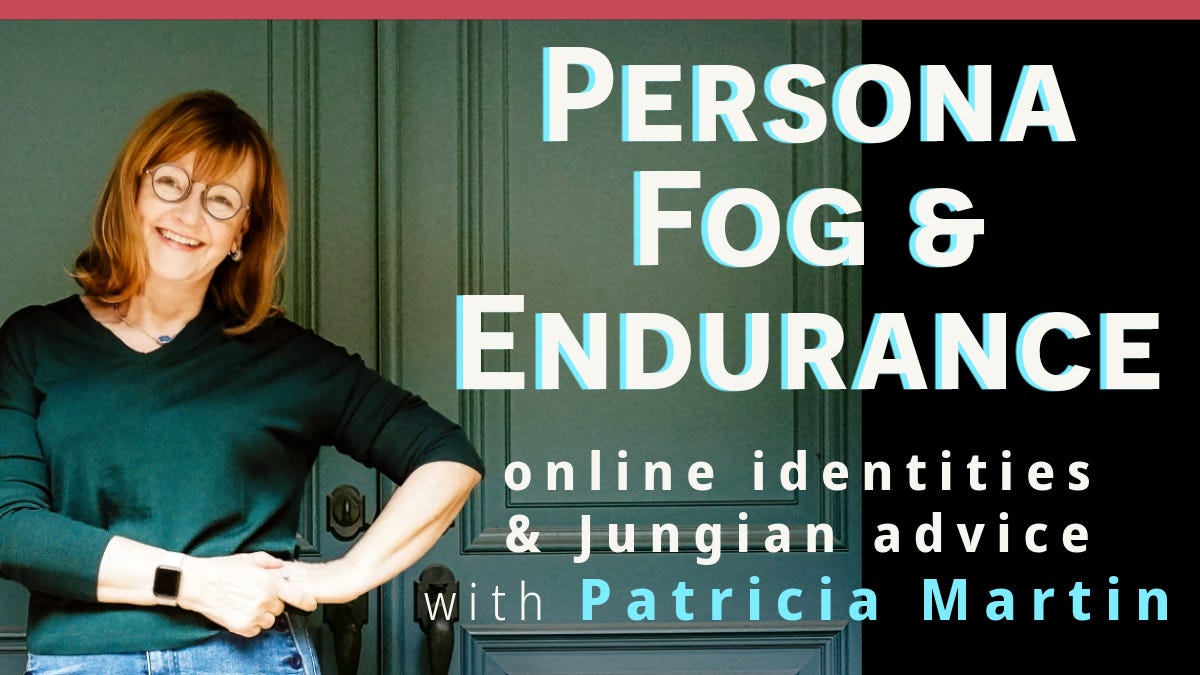
About Patricia Martin
Patricia Martin is a cultural researcher, author, and Director of the Institute for Psyche and Culture, a depth-psychology think tank based in Chicago. She is the founder and host of the podcast Jung in the World, now in its sixth season with over two million cumulative downloads. Author of four books, including RenGen, featured by the New York Times, and her latest, Will the Future Like You? (Karnac, 2026), which Kirkus recommended as an “incisive, fresh work.” For the past decade, she has led independent research on the erosion of selfhood through digital persona management, advancing her theory of persona fog. She completed postgraduate training in Jungian theory at the C.G. Jung Institute of Chicago and holds a certification in Medical Narrative from Duke University, an MA in Irish Literature and Culture from University College Dublin, and an MFA in nonfiction from Bennington College. She is a Research Affiliate of the National Association for the Advancement of Psychoanalysis.
00:00 Introduction: persona fog, endurance, and the art of enough
04:00 Missing the school bus and a childhood moment of transcendence
08:00 What the persona is, and why it was never meant to be load-bearing
11:30 The self as product and the post-identity era
17:00 What changed since our grandparents’ generation; the three factors of identity
23:00 From public libraries to the early internet
25:00 Patricia’s personal undoing and the question “Who am I?”
29:00 Fragmentation, resilience, and endurance
34:30 Persona, brand, and optimization; passion as endurance
37:00 Social pain online and the neuroscience of rejection
38:30 Movement, the body, and the micro-singularity of the self with its devices
41:30 Who listens to Jung in the World, and a yearning for depth
44:00 How Patricia found Jung; Jason’s story
48:00 Jonathan’s descent story and preparing to endure the AI era
50:30 Csikszentmihalyi, flow, and 45 minutes offline
53:45 The transcendent function, and the Jung lecture that inspired Csikszentmihalyi
55:00 Why high achievers can be the most fragile; chronic self-doubt
59:45 Janet’s story: auditing her “wardrobe” of personas
1:05:30 Love, attention, and Winnicott’s good-enough gaze
1:08:30 Why the self still matters; persona and romantic love
1:11:00 Listening as love, participatory sense-making, and stewarding attention
1:16:30 The spiral: returning to where we started, but anew
Links
Will the Future Like You? (Karnac)
Jung in the World podcast
C.G. Jung Institute of Chicago
The persona in Jung’s psychology (IAAP): https://iaap.org/jung-analytical-psychology/short-articles-on-analytical-psychology/persona-2/
Robert A. Johnson: https://en.wikipedia.org/wiki/Robert_A._Johnson_%28psychotherapist%29
James Williams in The Guardian (2017)
Vint Cerf: https://engineering.stanford.edu/about/heroes/2011-heroes/vint-cerf
Naomi Eisenberger, The Neural Bases of Social Pain (PDF)
Ray Kurzweil, The Singularity Is Near: https://en.wikipedia.org/wiki/The_Singularity_Is_Near
Mihaly Csikszentmihalyi (Claremont Graduate University tribute)
Donald Winnicott, Mirror-Role of Mother and Family in Child Development
Participatory sense-making with Hanne De Jaegher (Love & Philosophy ep. 68)
Love & Philosophy
Podcast and website: loveandphilosophy.com
Substack: lovephilosophy.substack.com
Support the show: Giving page
Transcript
Andrea (Intro): [00:00] Hey everyone. Today I’m joined by Patricia Martin, a cultural researcher who has been tracking a big shift in our society over the last three decades, and especially over the last 10 to 15 years, relative to what being online has been changing for us. She was there around the beginning of the internet, working with public libraries in America as they began to implement the web. Today she hosts Jung in the World (as in Carl Jung), a podcast that applies Jungian psychology to contemporary living, and it has reached listeners all around the world.
We’ll talk about that a little today, but mostly we’re going to talk about her book, Will the Future Like You?: Reflections on the Age of Hyper-Reinvention. It comes from research she’s been doing over the past decade, including a three-year ethnographic study with about 100 participants. She even created an early tool to help her analyze the data.
The book also came from some [00:01] personal undoing, which we talk about: some really hard things she went through in her own life, in her relationships and her family. She woke up one morning thinking, “Who am I?” and set off to figure out what it really means to build a self in this digital age.
One of the main themes this conversation revolves around is persona fog. In Jung’s model, the persona is a thin, outward-facing layer of the psyche. Patricia compares it to a user interface for social life, and it was never really meant to bear all the weight we’re now putting on it. We’re almost trying to put our bodies into this simulated interface online, and that is causing strange feelings for some of us, and for our society overall. We’ve created personas that are nothing more than a film or [00:02] a layer over us, or maybe a screen is a better way to think of it, and somehow that’s making us feel disembodied.
We talk about a lot of that. It relates to some of my own work too, but it’s really interesting to get Patricia’s views on this, and on the way we end up talking about resilience and endurance: what matters, and what continues to matter in our lives. Holding steady even when the ground is moving, as she points out. I think that’s a skill we’re all trying to learn in different ways. It’s part of why we try to think beyond either/or here, and to develop a way of staying balanced and still connecting to what matters to us even as we connect with the world. This connects to flow a little, and ideas like that, which we also talk about.
We even get to Winnicott at the end, [00:03] the idea of the good-enough parent or good-enough mother, the attentive gaze, and what it means to just be with “enough.” Enough is a word that comes up in a few upcoming conversations. The art of enough is something I’ll talk about with Jonny Thomson and his upcoming book. We’ve already recorded that, and I’ll be publishing it.
So we’re trying to think about what it means to find balance, but also to feel excited, to feel the amazing consciousness that is our life. We talk about that here too: how to really notice each other and notice what matters, and what it means to be human. Those are the themes we’ll be exploring in these next episodes, starting with this one, thinking of the spiral of how we move through life and always return anew. I hope you enjoy this episode, and I hope you’re doing well out there and not experiencing any persona fog. But if you are, you’re not [00:04] alone, and we can get through this together.
Missing the bus
Andrea Hiott: Hi, Patricia. Welcome to Love and Philosophy. I’m so glad you’re here today.
Patricia Martin: It’s my pleasure.
Andrea Hiott: We’re going to talk about Will the Future Like You?, which is such a wonderful title, Reflections on the Age of Hyper-Reinvention. There’s a lot in this book I want to get into, but I also want to give people an idea of who you are.
One scene that really struck me is when you were helping your teacher at school, I think in second grade, and you lost track of time. You came out of the school and realized you’d missed the bus home. The way you write about this moment, I feel like there’s a lot in it, because you sort of freeze, which reminds me a bit of things that come later, like persona fog. But the moment I want to start with is when you make the decision: “Okay, I missed the bus. I’ll just walk home.”
Patricia Martin: Yes. Which took me miles out of my way, but it was what I knew.
Andrea Hiott: Coming from this navigational [00:05] mind of mine, that’s interesting on so many levels. And then, having made that decision, at some point you saw the environment differently. You describe it so beautifully in the book, and I really hope everyone will read it, but it has to do with another level of consciousness, as you describe it. The trees suddenly came alive, and the water, almost like going through a portal and seeing life differently. For some reason I want to start with that moment. Could you tell me why that memory is important to you?
Patricia Martin: The reason I used that example is that I wanted to make the point that I’m not anti-tech. I don’t think phones should be ripped out of teenagers’ hands, because once we culturally make something taboo, they want it more. I think what we’re facing now is an issue of consciousness, [00:06] of understanding how we contribute droplets of consciousness through attention, and then find out later that we’re not capable of some of the very types of consciousness we yearn for most, which is transcendence.
What I describe in that scene is that as a little kid I had a moment of transcendence where everything around me came alive and scintillated. The air was thick, and I was part of this spinning world. I can still put myself back in that moment: standing at the top of the bridge, looking out at the river, a flock of birds taking off, and throwing rocks and hearing the gong as [00:07] they hit the water. I felt immensely alive.
There’s a Jungian, Robert Johnson, who says that sometimes we have that moment of consciousness when we are part of the world and it is in us, when the psyche resonates within us (psyche in this case meaning soul), and we’re too young to really grasp what it means. We have to revisit it at another time in our adult life. I found myself writing about it because I was trying to convey to the reader what this level of consciousness is, and I believe everyone has these moments. You’ve probably had one yourself, I’m guessing?
Andrea Hiott: Oh, yes.
Patricia Martin: Where suddenly everything is alive.
Andrea Hiott: Yes. I feel like I live more and more in that state. But this story is also metaphorical, [00:08] in a way, for the progress of the book, because there’s a kind of freezing with persona fog, which we’ll get into, and the stuckness. The word persona seems like a good way to start getting into these ideas. How should we think about what a persona is, or how it develops?
The persona and persona fog
Patricia Martin: First of all, in Carl Jung’s model of the psyche, the persona is the externally facing self, and it is the thinnest layer of the psyche. It’s like shellac. Or, to use a tech word, it’s your GUI, your graphical user interface, and it allows you to interact in the social world. It was never designed to be load-bearing. One of the problems of living in the digital age is that we are operating more and [00:09] more from the [persona], and we are asking it to be load-bearing. To use an oversimplified metaphor, it’s like trying to move a piano on a skateboard. It’s not meant to bear that weight.
This is why people feel fragmented, and it’s also why people are starting to develop what I call persona fog. Persona fog is a set of signals from the psyche telling us that we’re losing touch with any sense of inner navigation. Because it’s been fogged over, we can sense the core self, but we can no longer feel it, nor can we hear its signals, because the noise floor we’re living in has muffled it. This is [00:10] creating a lot of pain for people, and I heard it over and over.
I started with 200 participants in the ethnographic part of this study, and it winnowed down to a little under 100. There were 97 who stayed loyal over a three-year period. They revealed what was happening to them by spending so much time online, creating so many identities that they parceled out across various platforms, then having to mount personas for all of them, sustain them, and reinvent them. They were investing more and more identity into those personas and processes, and they were losing track of any [00:11] sense of a core self. It was like a hollowing out. This is where consciousness is demanded of us: we have to start paying attention to these symptoms, because they are signals. It’s the core self pounding beneath the noise floor, trying to tell us that something is radically wrong.
Andrea Hiott: I love how you frame identity. I can see a contrast between generations. There used to be a kind of identity where certain things were more regulated, or there were fewer categories. But now, as you say in the book, there are so many options and we have to be so many people, and we’re also living in this persona, or it becomes very confusing what isn’t the persona. And as you said, it wasn’t made to take the whole weight of life. Could you talk about what I think you call [00:12] a post-identity era, where the old scaffolding of who I am, which was a little more containable, has become something different?
The self as product
Patricia Martin: Yes. It’s something we just have to be conscious of, because what’s happening to us is unprecedented. In the digital age, the self has become a product. It’s an economic unit for sale, and the supply chain is social media. The more positive selves you can generate, the more money you make. And when you generate an identity, a persona, that is less popular and has fewer likes, you tend to abandon it, even though it might hold promise for exploring who you really are. So we begin to [00:13] edit the self.
The very definition of persona fog is when we have become so enchanted and entranced by the performance of the self, and the performance of multiple versions of ourselves, that we can no longer access the part of us that is genuine. This leads to a kind of self-estrangement.
It’s interesting to me, because for 30 years I’ve been tracking the culture. I track big civilizational shifts, and that’s why I wrote about this. I had no idea this was going to become the psychological prepper’s guide for entering the AI era. But here we are: fragmented, fragile, shrouded in chronic self-doubt, and yet we’re entering an age that is about to blow everything [00:14] open. That’s how much force it’s going to have on the culture, and here we are fragmented. So we need to pay attention to these symptoms.
Where I think this matters most is for people to understand a myth they have to let go of. It’s unspoken, and yet it’s so operational: the idea that what you put out there has no effect on who you are in here. It does. I tracked the data over 10 years. In fact, in 2016 I harnessed a rudimentary form of AI. I had a custom AI developed so I could gather large swaths of intent and preferences across 500,000 posts at a time, and have them bucketed and [00:15] analyzed, so I could see what people’s intentions were for themselves, what they saw in their future selves, and what they didn’t believe about themselves.
So I feel I stand on good authority, in terms of the rigor of my research, in saying that we’re entering a part of the century where the self is not only productized, commoditized, and optimized. It has also become a performance, which is a degraded sense of self. We’re no longer in search of the self, as we were in the 20th century. We’re confusing ourselves, because we’re interested in the performance of a self, and that’s a very fragile place to be.
Andrea Hiott: Yeah. I think a lot about this. Even when I think back to my [00:16] grandparents, they were definitely performing in a way. They would go to church, and that was a real part of them, maybe even the most important part. But there were always roles you played. I remember them not feeling like they could live up to that, and it was stressful. They wanted to always be the person they were in church, and they couldn’t always be. I’ve seen this in other ways too, with jobs and so on.
You describe what’s happening now as different. You talk about an ambient uncertainty, and even the fog itself seems like a different condition, the way you describe it. Is it because of the medium itself, which seems so disembodied? I think now it’s almost paralyzing: we want so much to live up to who we are, and online we’re also supposed to create these worlds that nobody can live up to. There’s a natural peril in that. You’re creating a situation that can never feel satisfied in some [00:17] kind of way. But we don’t think of it like that, which is part of what you point out is the problem. It’s the consciousness of it, understanding what’s happening, that actually makes an agential shift. Do you see what I’m saying?
Then and now: three factors of identity
Patricia Martin: I do. You’ve got a couple of questions in there. One is the before and after: what’s the generational difference? The other gets to the heart of how the coding has been engineered to create a sense of inner chaos, because that chaos is useful and can be monetized. Let me take them one at a time.
First, what’s different from our parents’ generation. They played fewer roles than we have to play now. There was a communal clarity that was shared. [00:18] You mentioned your grandparents going to church: there were roles within communities, and there were ways communities saw each other. The famous anthropologist Claude Lévi-Strauss said this about any rite of passage: first you have to see yourself, and then you have to see yourself in community with others. That’s why there’s always some mirroring exercise in a ritual, and then you have to look out and see your community.
That’s what church did for people. That’s what community did for people. That’s what going to school did for people. And now even the idea of going to school was tested through COVID; online learning has become a bigger and bigger approach. So there’s less community. We live more and more [00:19] virtually, and we work more and more virtually. We don’t go into an environment with others and test ourselves in that communal way that gives us a sense of who we are. So the virtuality of our lives is vastly different from our parents’.
Then there’s the sociology at work. Women’s roles are radically different. We now have science that lets people change gender. We control our ability to reproduce, scientifically and biologically. These are big shifts that add up, and I’m only touching on some of them. I think this has created a current cosmos where there are just fewer ways to really understand who you are.
And if I may, [00:20] I want to toggle over to the second piece, which is how the internet is programmed. I feel like I’m talking a lot, but you’ve asked some really provocative questions.
There are three factors to identity. This is a little oversimplified, but I could get agreement from most psychologists on these three. One is how we see ourselves. The second is how other people see us. The third is our will to shape ourselves.
How we see ourselves has become fogged, so it’s not holding us up the way it used to. What has become primary is how others see us, because we’re willing to hyper-reinvent in order to please an audience. [00:21] And the third, human will: James Williams, a former senior person at Google, admitted publicly, and it was quoted in The Guardian, that the internet has been coded to reduce human will.
So some of this is just what we’re in. It’s not something we’re doing wrong. We’re just now starting to suffer the symptoms of what we’re in.
Continuity, scripts, and breaking them
Andrea Hiott: As you were talking, I was thinking about how far-reaching the implications are, as you show in the book. I was describing my family performing in a social environment, whether church or something else. Now it’s very strange, because a lot of us wake up and feel like we have to start performing online, or [00:22] check how our performances are going in all these different areas, which are very amorphous. We’re presenting all these versions of ourselves because each of those environments has been sculpted to work in a certain way, so you need to sculpt yourself to fit it.
I don’t do any of this, by the way, and a lot of friction comes from that. It’s hard if you go against it, because you will see it and feel it in the likes or the lack of likes.
I’m trying to get at how this started to matter to you. I think continuity is a word that’s coming up here too. It seems like this is a very continuous thing; we’re building our self-esteem through this sense of continuity. A lot of what we’re addicted to is the continuity, and that’s what many of the coders and builders have latched onto: we get on these scripts and we have to stay on them. We wake up and want to log back into [00:23] them. It’s a very physical, bodily thing that happens, beyond reflection. But sometimes in our own lives we need to break that continuity in order to realize we were stuck in those scripts.
Patricia Martin: Yes.
Andrea Hiott: You show this in the book, but how did you get to a point where you could do that?
From libraries to the early internet
Patricia Martin: Well, it wasn’t pretty, I’ll tell you that much. I’ve been researching big civilizational shifts, and what they mean for people in their daily lives, for 30 years now. I was the beneficiary of being in the right place at the right time. I was in my early 30s and working with libraries in America. The United States has been very blessed with a network of public libraries. Public libraries are a larger franchise than McDonald’s restaurants.
Andrea Hiott: Wow, I [00:24] didn’t know that. I love libraries. I just have to say that, everyone. Libraries are so wonderful.
Patricia Martin: They are so wonderful. It’s such a treasured resource in every community, and it is unparalleled anywhere in the world. So I was working in that function and, lo and behold, this thing called the internet came into being. We were the installed base for information sharing in America, and we became allies of the early internet. I found myself sitting in meetings with Al Gore’s team, figuring out how we were going to get people to use the internet. I know that really dates me, so I’m an elder stateswoman in some regards. And I worked with Vint Cerf, the father of the internet, on a project.
So I was an early adopter, and I became more and [00:25] more intrigued by the internet as a cultural force and how it was going to shape us. I decided I wanted to research it and write about it. But I didn’t realize I was going to take this psychological bent until I went through a series of personal setbacks. It was really an undoing of everything that defined me.
An undoing: “Who am I?”
Patricia Martin: Within a short period of time, I went through an amicable divorce. I had to move three times in 18 months. Through this process, I heard from my brother that my mother had taken a fall and died immediately. Our mothers are really the anchor to who we are, in [00:26] many regards, so that got untethered.
Then my youngest child, who was in college at the time, sat me down and told me he wanted a name change. He was no longer going to be Molly; he wanted to be Hank. I could never have anticipated how much investment I had made in the gendering of my child. I don’t feel shame around it now, but I’m kind of stunned at how much parents project gender onto their kids.
Oh, and then a major project that was a lifeline to my bank account [00:27] got canceled, and I was going to have to reinvent how I made a living.
All of this happened within a three-year window. I woke up one morning staring at the ceiling, asking the age-old question, “Who am I?” That’s when I decided I wanted to study what it means to build and rebuild our sense of self in a dynamic digital age. I lit out like Huck Finn, determined to go to every stop down that river to get to its mouth, where the big thesis lay. And that’s what I did.
Andrea Hiott: You sure did. You really left nothing unexplored. I can feel the research. A lot of it is very bodily and in person, too. You did a lot of interviews with real people, not just [00:28] collecting and sifting through data, but actually looking at stories and narratives. That’s why the word continuity seems so important.
That’s a lot of what you went through. I just want to give it a minute and respect that, because a lot of people have times in life where they wonder how they could possibly get through it, and you just keep getting through it.
The continuity there is interesting, because in a way that was a break of continuity in your life in so many ways. Even spatially, moving between apartments: how that affects what we’re capable of being as thinking, feeling bodies is so disruptive. But at the same time, I feel like you were exploring paths in a way that brought something. You were almost covering the surface, finding a continuity that’s not about linear continuity. Does that make sense to [00:29] you? It’s almost like you start reaching toward what you thought were edges and fringes, because you’re now able to look at them. Maybe because you love the people in your life and you’re having to see them differently, you start to see the world differently.
Fragmentation: resilience versus endurance
Patricia Martin: Oh, yes. You’re making a lot of sense, and I want to talk more about your idea of continuity. What we keep as our core self and choose to expand, as opposed to what we discard: we’re organically building identity all the time in that way. That’s normal.
But you’re hitting on one of my key findings, which was about fragmentation. Being so many selves, projecting them out on various platforms, enhancing them once they [00:30] get attention and discarding them when they don’t: this put us through a gauntlet of hyper-reinvention. And what was it costing us?
One thing that relates to continuity is the sense of endurance. Over the last three decades we talked a lot about resilience, because there was a lot of disruption caused by the internet, and that disruption was episodic. Amazon took over the book world and sort of crashed publishing, to give just one example; there are many others. But now I think the [00:31] body politic, the collective, as Carl Jung would call it, is facing a different problem: endurance, being able to endure the chaos and the complexity.
That’s different from resilience. Resilience is: I get the wind knocked out of me, I catch my breath, I pick myself up, and I march on. Okay. But now the ground is moving underneath you so fluidly and so quickly. Bounce back to what? You’re not standing in the same place once you stand up.
What I was feeling in people was a yearning for what you might call continuity. I would call it being able to endure [00:32] the pain of deciding and sticking to what they understood as their core self, and letting that be self-determined. That’s harder and harder to do.
Culturally, there’s a lot of messaging right now that all this discussion of the self comes from the self-help porn sold to us starting in the 1980s, and that it’s all just self-indulgent. There’s some truth to that. I’m not trying to take us back to the “Hey, go find yourself” age. I’m merely reporting what I found out in the field. People felt [00:33] like a box with a bunch of fragments inside, and they couldn’t get the fragments to cohere in a way that let them endure difficult situations, like having their entire careers upended.
So as we enter the age of AI, I’m sounding the alarm: we can’t just abandon the self, because it’s our operating system, and something has happened to the operating system. It needs coherence so we can endure what’s about to happen.
Andrea Hiott: Yes, that makes a lot of sense to me. You talk about entering a new period, and you start talking about identity more as a movement, and that we’re realizing it’s a movement. I’m still not sure how to talk about the persona here, [00:34] in the Jungian sense of the social mask, or how it relates to what you’re saying about endurance, because endurance is such an important word. For me, it puts things back in the body. Continuity is almost more like a measurement, and endurance is how it feels to try to keep going and persist.
What role is the persona playing in that? It’s a social mask, and it’s necessary, as you’ve said, but it’s only a veneer of the self.
Patricia Martin: Yes.
Andrea Hiott: It’s not what’s enduring. But we’ve somehow misplaced endurance, so that now we think the persona is what has to endure. We’ve created all these personas that we’re trying to keep going, but we don’t feel them as the self in our body.
Passion as endurance
Patricia Martin: Yes. We’ve relegated the self to the persona, and then the persona has been relegated to a brand, [00:35] and we’re either on brand or we’re not. We’ve accepted optimization instead of development and growth, because it’s easier to have a listicle of five things to do to make the psychological pain go away than to endure.
I want to lean into this idea of endurance, because I think you and I are on common ground with your notion of continuity. The idea has ancient roots. It comes from the Latin pati, which is to be able to suffer amid uncertainty and hold oneself stable. [00:36] And the word for it wasn’t actually endurance; it was passion.
We think of passion as an emotion, and the internet is full of a lot of fake passion. But passion really meant endurance. That’s where the phrase “the passion of Christ” comes from: he was willing to endure for some greater transcendence to occur. Each of us, in our own ways, needs to be able to endure uncertainty, and to endure what comes of deciding, in a self-determined, sovereign way, who we are, and of [00:37] coming forward with that self in a way that’s self-loving and honest, and enduring whatever hardship comes of that.
Social pain online
Patricia Martin: We’re not willing to do that. There’s a fascinating set of studies from UCLA’s Naomi Eisenberger, a social psychologist who studied social pain. She found that social pain, which also translates to social pain online, when a persona you’ve put out there meets rejection, travels the same neural network as physical pain. So when you’re rejected or bullied online, it’s akin to a punch in the face.
So we’ve become very worried about erring online with the wrong persona, [00:38] and meanwhile we’ve put our core self out of reach. And it’s not leading us anywhere good. That’s the conclusion I come to in the book.
Movement and orientation
Andrea Hiott: So many exciting things in there. Two things are so important to what I’m doing philosophically, and to why I even do this work. One is what you brought up about being able to sit in ambiguity, or holding paradox. It’s not about trying to dissolve things. It’s sitting with what you were describing as the passion, or the suffering, in a way.
The other is movement. We’re learning how to orient within what is already moving. It’s almost like feeling into the movement enough that we can then orient ourselves, instead of always being oriented by the algorithms or whatever is [00:39] getting our attention. Does that make sense to you? I’m thinking of those moments when nature becomes alive. There’s a kind of presence, or consciousness, that comes through being able to sit with the suffering or see the world differently, and that can maybe help us feel that movement and orient within it.
Patricia Martin: When you say movement, do you mean a sense of physicalization?
Andrea Hiott: Well, that’s another point you raised. For me, we are bodily moving in a lot of spaces at once. The online world, like in those studies you mentioned, is one world we’re moving through, and our bodies are affected by its set of regularities just as they would be in a geographical space. But we don’t think of it like that. Because these regularities are so different, when we’re online our bodies are experiencing it the same way, but the actual [00:40] regularities are so different that it can feel isolating and strange. If you get off your computer or put your phone down, it can feel like you’ve given up a part of your body at this point, because the body is so literally part of it. But we don’t think of it that way.
So when I say movement, I really mean it in all these spaces, psychological, emotional, and bodily: the way we make our way through them, or encounter them, and the scripts we build with them.
Patricia Martin: This is reminiscent of Kurzweil’s theory of the singularity, but at a micro level. The singular self now has attachments. It has a phone, it has earbuds, it has technology in order to be whole. So when we set our phone down, we don’t feel [00:41] whole. There’s a micro-anxiety about that, which many people don’t want to experience.
I think you’re onto something. I didn’t write about that per se, but I think we’re riffing on where this is going. These are my early sensations as I continue to research these topics.
Jung in the World and a yearning for depth
Patricia Martin: Here’s what I’m seeing. I have a podcast called Jung in the World, where we apply Jungian theory to contemporary living, and I have a wide variety of guests. When we studied who was listening, we found listeners from around the world, which isn’t unusual. But among those 2 million, we had [00:42] mostly 18- to 30-year-old men.
What this said to us is that there is a yearning for depth. Jungians are depth psychologists. They’re not about small behavior changes that add up to something. They take you deep into your dream world, into the symbolic journey of building a self, and into your shadow work.
This was a big signal to me, and I’ve started to follow it. Now I’m studying what it means, in digital culture, to reintegrate the pieces, [00:43] what symbols and myths we have around that, and what self-mythology we have about wholeness in the midst of the singularity. I know this is all very ethereal, but this is what does it for me.
Andrea Hiott: Oh, I love it.
Patricia Martin: It makes me really boring at a cocktail party, I might add.
Andrea Hiott: I would say the opposite. You’re the one I’d want to talk to. I think it’s exactly what I’m trying to get at with endurance, and the way you linked it to passion. There’s a depth there, and there are already paths that connect us, that we want to feel back into, especially a lot of younger people. Jung has that archetypal quality. And the chronic self-doubt, the cascading crossroads: there’s a lot of movement and navigational metaphor in your work. All this feels a little detached from that, but if you feel into it, [00:44] it shifts how you see those things.
I also seem to remember that, although you have this wonderful podcast about Jung, you discovered Jung through having to endure, and through doing this research. I remember it was snowing and you were going into the archive or something. When did Jung come into your life?
Finding Jung
Patricia Martin: Yes. I had to endure the shame of not knowing. As I started talking to the cohort of participants I’d built for the study, and we live in a very confessional time, it didn’t take long for them to start confessing to me their agony, their confusion, and their anxieties. [00:45] I was in over my head, and I felt some shame around that. I decided I didn’t want to feel that shame anymore for not fully understanding, and I didn’t want to be a passeur and just say, “Well, I’ll figure out a name for this.” So I decided I would have to anchor myself in a school of thought in psychology.
At its foundation, psychology has two founding fathers, if you will: Sigmund Freud and Carl Jung. That was kind of a no-brainer, because Jung advocated for the soul in a way Freud did not. I also found Freud less friendly to women in general; that was just my take. So I signed up for a two-year course of study at the C.G. Jung Institute in Chicago, where I live, [00:46] and I became hooked on Jung’s work as a way of living and a way of seeing the world.
Jung was a scientist. He was an MD, as was Freud. But Jung took his work toward understanding that the self is a seed. The self has its own sense of direction. The psyche is self-healing. I studied the canon of Carl Jung for two years, and that gave me a basis. It also gave me the courage to start listening differently.
People were telling me their woes about having lived online for so long, with such intensity. Take [00:47] the story of Jason, who wakes up one morning and his beard is falling out in handfuls. His anxiety is cranked up to such a pitch that he’s afraid he’s dying. He’s 27 years old and has a big online life. This is not normal. And it was case after case of this. When you hear cases like that lined up one after another, just from this random cohort, you have to start saying to yourself, “There’s something civilizational happening. There’s something happening in the collective,” which is also accounted for by Carl Jung. That’s when I became a Jungian.
Andrea Hiott: Is Jason the one who decided not to take the big VC [00:48] deal, changed his life, and started looking for smaller things that made him happy?
Jonathan’s descent story
Patricia Martin: No, you’re thinking of Jonathan.
Andrea Hiott: Jonathan, okay.
Patricia Martin: He had built an online community where people could tell stories, and he could track the patterns in those stories. He was a data genius as well as a computer scientist, and a venture capitalist offered him a big deal to buy his online community. He woke up the next day and realized it wasn’t who he was or who he wanted to be, and he canceled the deal. That won him no favor with people, who thought he was nuts for doing it. [00:49]
Then he had to undergo his own descent story. He lost his girlfriend. He lost his apartment.
Andrea Hiott: Yes, I remember.
Patricia Martin: It was one thing after another. These descent stories also started adding up.
Andrea Hiott: A hero’s journey kind of thing.
Patricia Martin: Yes. But here’s where we’re asked to endure. I worry that these descent stories are going to be really common in the next five years, once we become a world operated largely by artificial intelligence, and we’re not equipped the way we should be.
So what can we do about that? I don’t have a set of listicles; the algorithms love those. [00:50] I can only say what I know after studying this for 10 years. Number one, we have an obligation to ourselves and to others to be conscious of how we use AI and what it does to us. That’s on us. The other thing I’d say is to drop the myth: whatever content you’re putting out there affects you, and whatever you give your attention to is a droplet of consciousness.
Flow and 45 minutes offline
Patricia Martin: I had a profound meeting with Mihaly Csikszentmihalyi during this research. He developed the theory of flow, which is about entering a state of heightened consciousness. He studied [00:51] artists, musicians, and athletes, who entered a place of transcendence in their work where time disappeared and boundaries disappeared. They became the best versions of themselves, and they did that through focus.
His worry was that we were entering a world where his theories would become irrelevant, unachievable even, because we had so tampered with our ability to focus by dribbling out our consciousness without knowing it. So being conscious is really important, and so is attending to our ability to hold consciousness. That gets to the third point we’ve touched on: the ability to endure what it feels like to [00:52] not be on the internet for 45 minutes.
I think we should all be able to do that. It’s like sit-ups. I practice it every day. I’m not on social media, and people think that’s a joke, as if I’m being insincere. No, it’s a choice. I understand what it’s doing to me. I think we ought to be able to bear that. It’s good for us to be able to bear it.
Andrea Hiott: I absolutely agree. I think this is the skill of the future: being able to stay with the tension. Not even sit, because you’re still moving, but stay with the trouble, hold the tension, hold the paradox, whichever way you want to say it. Then, of course, we want to reorient, because we’re always moving; we don’t just stay stuck in there. But first you have to come into it, as you show in the book with your own examples and with the research.
You also talk about how attention is something we [00:53] channel. I think there’s a quote, maybe yours or maybe Christof Koch’s, about attention being something we channel ourselves into. It becomes action; it’s actionable. So reclaiming your attention, noticing that it’s been taken by all this stuff you maybe don’t care about, is uncomfortable and not easy. I think it’s good to know that it’s okay that it’s not easy, and that we can help each other. That’s why your book is so helpful: “Okay, this is hard, and maybe I’m going to go through some hard stuff, but other people are there too.” Just knowing you’re not alone can be so helpful, can’t it?
The transcendent function
Patricia Martin: Yes. And this gets back to Jung and the passion of endurance. It’s holding that tension that births the transcendent function. [00:54] If you can just hold it long enough, and feel the discomfort of it, something else emerges that is completely of its own creation.
This is where Csikszentmihalyi started to write about flow. It’s really interesting to me, by the way, that when Csikszentmihalyi was very young, he sat in on a lecture Carl Jung gave.
Andrea Hiott: Oh, I didn’t know that.
Patricia Martin: Yes. He went home and decided he wanted to be a psychologist.
Andrea Hiott: Wow. I hadn’t thought of that. I think everything we’re touching on is very connected: flow, his work, the role of attention, Jung as the source, opposites that aren’t really opposites. It’s all in this kind of movement we’re talking about.
There are two or three [00:55] other things I really want to talk about, but we don’t have a lot of time left, so I’ll put a few out there and you can take whatever you like.
One is fringes and edges. You explored all these different things that hadn’t been central in your life before, talking to a tattoo artist and so on. I’m not sure how it connects here, but it seems to.
The other is something so interesting in your book: the people with the most self-esteem are often the most fragile. We usually think it’s the opposite. We think that if we become the super-person online, or in whatever world we want to become great in, then we’ll have confidence. But I’ve definitely seen in my own life and in others that you actually become more fragile. That’s a really [00:56] interesting point in your book. And I think it connects, because once you’re in that space, it becomes harder to explore and be messy. Those two things kept coming up, especially the second, which is a really important insight.
The self-esteem paradox
Patricia Martin: The idea of self-esteem was very much in vogue in the 2000s: the notion that most psychological problems could be boiled down to self-esteem issues. Culturally, it made its way into television, storytelling, and schools. People believed that if you could just raise someone’s self-esteem, they could self-correct, [00:57] not only socially and economically but psychologically.
I found that the opposite was true. I was talking to people you wouldn’t describe as having low self-esteem. They were high achievers with every reason to be confident about who they were, and they had a lot of agency in the world. These were people who could make things happen: entrepreneurs, artists, people who could manifest physical things. And yet they suffered from an inability to create a sense of a future self. When I asked them, “How do you see yourself in the future?” I was met with silence.
Andrea Hiott: Hmm.
Patricia Martin: This stunned me. They were uncertain. Following this chronic self-doubt issue, I sensed that what had seeped [00:58] into their mindsets was a shadowy sense that failure could be around the corner at any time. They had built worlds upon worlds inside the internet, and somebody was at the switch with the algorithm, and the bottom could fall out of everything at any minute. Because we’re all workers on the plantation; we don’t own the plantation. It’s not collectivized. And that has real economic, cultural, and creative consequences for people.
That’s when I really began to see how much of ourselves (our aspirations, how we see ourselves, who we want to become) has been invested in how we’re perceived by others, and this is unprecedented. [00:59] There’s nothing in history like it; I looked. So this isn’t a self-esteem issue. In fact, people felt a lot of discomfort around it: “I can solve all these other problems, and I have all this agency. Why don’t I feel better about myself? What’s not working?” They had no understanding of what these signals meant, and neither did I. We had to figure it out together, in many ways.
Andrea Hiott: Yes, you were moving through it too, discovering these things and now sharing them, which is part of this wonderful journey.
You also present self-regulation, and you talk about prototyping. As you said at the beginning, you’re not saying technology is terrible. [01:00] It can be used for terrible purposes, but it’s about being conscious of it, what we want people to create, and what we choose.
Maybe you could talk about Janet. There are people in this world who are getting tons of followers and making it, and they start to realize they’re losing that endurance, that passion, that will. The persona becomes like a balloon floating over there, no longer connected to them. And they decide, “Okay, I’m going to sit with the friction. I’m going to sit with this not being comfortable.” Somewhere you have the idea that doubt is the ego’s language of rebellion. So: “I’m going to go against the grain and see what I can discover for myself.” Then they start using these online tools to do that, which might mean [01:01] fewer likes, or bad comments, because they’re not fitting the algorithm. In a way that becomes a rebellion, a beautiful rebellion, if you’re doing it from your own movement, from what really moves you and what you care about, having been able to sit in the discomfort and reorient. That’s a very positive part of the book we haven’t gotten to yet, one that offers a path forward.
Janet’s story
Patricia Martin: Yes, and I’m so glad, because this is a great place for us to end, on the high note of what we can do. This is the story of Janet. Very quickly: Janet was a rock star online. In high school she was a STEM student, so she learned to code early. I can’t even number the platforms she was on. She adopted every new platform as it came along: Instagram, [01:02] Facebook, the typical ones, but also multiplayer games. She had all these archetypal identities: her avatars, all her different social selves.
Now she’s 17, she has a very promising future, and she has to apply to college. She has to write an essay about herself, and she draws a blank. She doesn’t know how to talk about herself. And this isn’t a writing problem; it’s a self-image problem.
So she decides to spend a weekend looking through every single persona in her wardrobe [01:03] and assessing each one on how true it feels to her, not to anybody else. She set the boundary that it didn’t matter how many likes something got. That was not her benchmark. Her benchmark was, “Is it true to me?” If it wasn’t true to her, she decided to get off that platform.
Andrea Hiott: Thank you, Janet. What a smart young woman. I just love it.
Patricia Martin: Right? So smart. At 18 years old, she’s hitting no, or pause.
Then she looks at the parts of herself she had negated. Self-negation is a big part of persona fog: you begin negating parts of your true self that hold a lot of promise for who you might become, because they haven’t gotten a lot of likes, reinforcement, validation, popularity, or shares. This is where the title of [01:04] the book comes in: Will the Future Like You?
She decides to take her future into her own hands. If something was true to her and it fell on deaf ears, she was going to bring it into the wardrobe and keep it there. Then she sat down and wrote a sovereign paragraph saying, “This is who I am now.” She had clarity, and from that she built her essay.
Needless to say, she got into an elite university with a merit scholarship. The rest is history. But what stunned me about her was that she was taking command of her identity at such a young age, because she had the consciousness to see what the internet had done to her sense of self. And she took control.
Andrea Hiott: That’s what I was about to say. For me it’s not about the [01:05] credentials and getting into college, which is wonderful, and I’m happy for her. It’s such a powerful thing because she was able to reorient her attention at such a young age, and at such a crucial time, and feel her power again as herself. So many people want to do that, and it’s so hard, especially at that age, when you’re literally going against what you think everyone is telling you is cool, or what they like. It’s such a powerful thing to be able to do that and continue.
I think it also connects to caring and mattering and love, which is important to me and part of all this. It’s definitely part of the story you tell; I feel it in your story. It also seems to have directed your story, whether with your family or otherwise. So I want to ask you about that word, and whatever comes up for you.
Love, attention, and the good-enough gaze
Patricia Martin: [01:06] Are you asking me about the word love?
Andrea Hiott: Yes. What role does it play in these themes? Maybe in writing the book, but also when we sit in this tension: is love there too? Is it a kind of attention? What do you think?
Patricia Martin: Oh, yes. Absolutely. Love has always been tied to what we attend to, what we give our gaze to. I love the work of Donald Winnicott, who was a Freudian psychiatrist. A little tidbit: I find that psychiatrists tend to be Freudian in their early years and then mature into Jungianism. They rise to Carl Jung’s work after they’ve lived enough and seen enough to say, “Oh, he’s onto something.” [01:07] And so he became a Jungian later in his career.
He was a child psychologist, and his was the theory of the good-enough mother. The good-enough mother is one who can put her gaze on the child and see the child for who the child really is. This isn’t about cheering the child on. It isn’t about praise or validation. It’s strictly giving one’s attention to the child as a nurturing form of love and sustenance, and that gaze builds in the child the confidence to endure, the confidence to become who they really are.
I’ve really taken this on in my daily life, in everything I do. Before sitting down with you today, I picked up a [01:08] cup of coffee at my local coffee shop, and I consciously made eye contact with the person taking my money and pouring my coffee. I attended to them with a sincere gaze, because that’s what I can do as a human being to make the world go round. If we all understood the power of our gaze and our attention, I think there’d be more love in the world.
Why the self still matters
Patricia Martin: I may have drifted off course, but what I also want to say about love is this. There’s the Lacanian idea that [01:09] there really is no self: that we’ve over-invested in the self, over-indexed on it, and we shouldn’t worry about it so much; what we should worry about is how the self gets translated into the world, what we can do for others. There’s truth to that. But this negation, the idea that the self doesn’t matter, is very convenient, because the internet would love you to believe it. Then, when you start to lose your sense of self, you won’t notice. You have less at stake.
I’m telling people it’s time to update our sense of self, and why it matters, for the 21st century. Because if we can’t do that, we can’t genuinely love anybody, and we certainly can’t love ourselves. And the science [01:10] bears this out. People who had over-invested in persona also faltered at love, because they didn’t believe the other person really loved who they were. They believed the person they were in a romance with had fallen in love with their persona, so the love couldn’t be trusted. I think that’s so sad.
And I often wonder, Andrea, whether that’s part of what’s at play in all the tension online around heterosexual romance and love, with the genders widening the gap of understanding. I wonder what role persona, and the lack of real, [01:11] genuine human attention and focus, has played in that. What do you think?
Listening as love
Andrea Hiott: I think what you just said is so important. You said you were meandering, but I think you’re right on point with listening as love. Listening is such a gift, if someone is attentive to you. It’s one of the greatest gifts we can give each other. Attentive in the sense of not asking what you can get out of this person, and not looking because something is cool and everyone else is looking. It’s your bodily, full, enduring, uncomfortable self orienting and mattering toward someone. That’s how I think of it. Your very life force [01:12] is moving toward the person, or able to sit with and listen to them. When you can just be there and not be trying to get something or shift something, what a gift that is. For me it’s very connected to what love is, in a bodily, caring, mattering, becoming sort of way.
I think that’s the hard puzzle: how to let each other matter in that way without first looking at each other’s stats.
Patricia Martin: Their [unclear] scores.
Andrea Hiott: Yeah, all of that. I do think everyone is hungry for it, but everyone’s afraid to do it, partly because we don’t see it modeled. And it is hard. It takes a lot of energy to be present.
Patricia Martin: It does. But you’re wasting that energy [01:13] someplace else, so be a steward of your own attention resources, is what I’d say. And by the way, this is incremental identity development. This is identity formation you have chosen. This is your will being reclaimed. Remember, you’re living day to day on an internet designed to upend your sense of will.
So I’m practicing, in small ways, deciding who I want to be: when I pick up my groceries, when I pump gas, when I meet someone on the street, when I get a haircut. Wherever I am, I’m deciding who I want to be by giving [01:14] my gaze to another human being and making a connection. Because, just like Janet, that’s who I want to be, and I won’t become that unless I take back my will. And we do it in small ways.
Andrea Hiott: That’s very beautiful, and thank you for that. It’s a wonderful way to live, isn’t it? It’s actually much more satisfying than what we’ve seen modeled and confused ourselves into thinking is the goal. What you’re describing is very sustaining. It’s a wonderful way to be alive, especially if you’re in community. You talk about belonging as a kind of survival, this nestling-in feeling. When you’re in a community that supports that, it feels like a great life. It seems kind of strange: why would [01:15] we... we don’t even need all the online stuff.
Patricia Martin: If you go back to where we started in this interview, you were talking about your grandparents having a sense of belonging to a community that was ritualized, maybe through going to church or other kinds of belonging. That’s how they saw each other: I see you, and you see me, and that is very confirming. This is what we reclaim when we give our gaze in a meaningful way. And the bonus is that you unlock the flow of life force in the other person.
Andrea Hiott: It resonates with participatory sense-making.
Patricia Martin: Yes, exactly. [01:16] Now you’re in the generative flow of it. And what are you doing? You’re buying a coffee and having a moment. It only has to last three or four minutes, but it’s going to get you through your day. This is how we’re going to rebuild what it is to be human. I believe this to my core.
Closing: the spiral
Andrea Hiott: I believe it too, and I thank you for your work. I think we don’t even know what’s possible when we really do that. We’re not going back. We’re coming back to where we started, but it’s a spiral, so it’s never really where we started. We have Jung now, and all these things, and maybe we can sense into the world even more than we thought possible. It’s not that we want to become like our grandparents, because they also had a lot of pressure and conflict. But even in this conversation, we’ve come back to where we started, and it’s a very different place, right?
Patricia Martin: Right. It’s been a [01:17] great journey. Thank you for taking it with me.
Andrea Hiott: Thank you. Thank you for your book and for all that you’re doing. I’ll point everyone to your wonderful podcast and, of course, the book. If there’s anything else you’d like to share before we go, please go ahead.
Patricia Martin: I look forward to your book coming out too.
Andrea Hiott: Oh, thank you.
Patricia Martin: Yes, I’m eager to read it. This has been a great connection to make. I appreciate that the two of us are intellectual omnivores who see the big picture. It was really fun to be in conversation with you, Andrea. Thank you.
Andrea Hiott: Same, Patricia. Thank you.


