


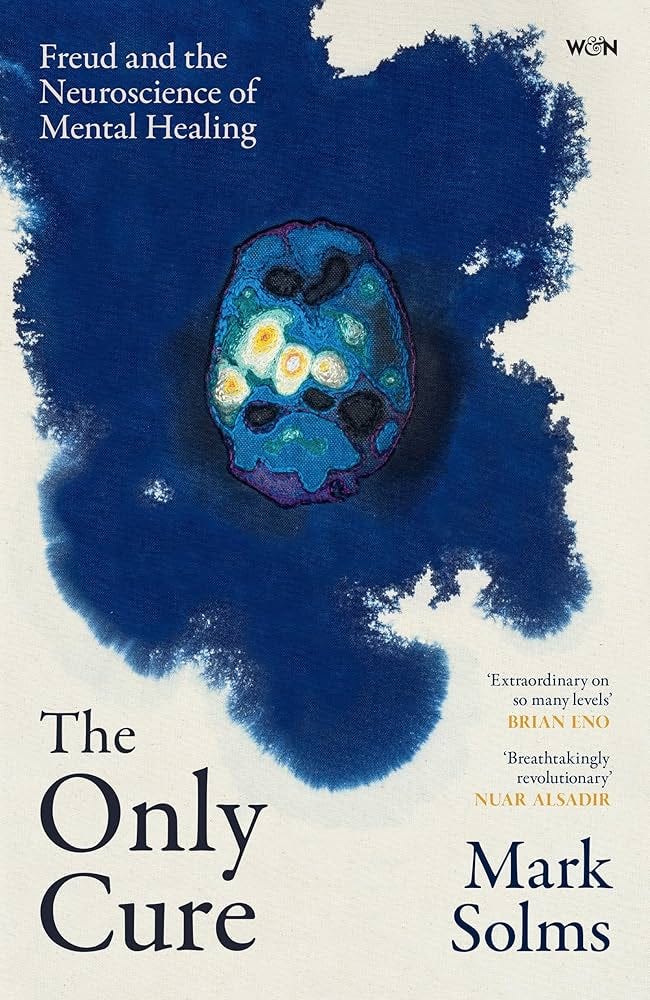
Mark Solms began translating Freud’s neuroscientific writings in the late 1980s, then gave twenty-nine years to revising the translation of Freud’s psychological works. In this episode, Solms joins Andrea Hiott to talk about his new book, The Only Cure: Freud and the Neuroscience of Mental Healing — and to make a surprising case: that far from being the discredited figure many take him for, Freud built a model of the mind, from the inside, that modern neuroscience is now confirming from the outside.
Together they explore multiple memory systems and the unconscious as things we repeat rather than remember; why transference is a far bigger phenomenon than its jargon suggests; the damage done by the “chemical imbalance” story of depression; the stubborn role of time in real change; and, in the end, care — the idea that psychoanalysis is ultimately a cure by love. Throughout, they return to the show’s animating theme: holding paradox, and refusing the false choice between the subjective and the objective, feeling and fact.
They discuss dual-aspect monism, subjective and objective perspectives, multiple memory systems, unconscious processing, state-dependent memory, and transference as the enactment of non-declarative “action policies” that therapy makes visible and revisable through repeated working-through over time. Solms links these ideas to care, politics, and mortality, ending with Freud’s “cure by love,” followed by Andrea reading Seamus Heaney’s “From The Cure at Troy.”
About the guest: Mark Solms is a neuropsychologist, psychoanalyst, and world-leading pioneer of neuropsychoanalysis. He discovered the brain mechanisms of dreaming, serves as science director of the American Psychoanalytic Association, and is the translator and editor of the Revised Standard Edition of the Complete Psychological Works of Sigmund Freud. His previous book was The Hidden Spring (2021).
00:00 Welcome and Guest Intro
03:50 Freud Translator Journey
05:20 Why Call It Cure
07:00 Reframing Freud Today
11:41 Freud as Neuroscientist
19:57 Memory Systems and Unconscious
31:41 Subjective Meets Objective
39:08 Chemical Imbalance Myth
43:23 Needs Feelings and Therapy
51:03 Pills Versus Talking
52:09 Limits Of Medication
53:31 When Pills Help
54:41 What Is Transference
56:04 Infantile Amnesia
57:17 Interpreting Patterns
01:01:25 Why Therapy Takes Time
01:04:46 Cost Versus Care
01:10:59 Teddy And Polypharmacy
01:19:20 Short Termism Trap
01:23:13 Cure By Love
01:25:37 AI Therapy Limits
01:31:25 Mortality And Meaning
01:34:55 Closing Thanks
01:36:09 Heaney Poem Easter Egg
KEY THEMES
Freud was a neuroscientist first. Over 23 years he contributed to neuron theory, neuroanatomy, and clinical neurology. His 1891 work on aphasia reframed language as a psychological function — the seed of psychoanalysis. Because his neuroscientific writings were never translated into English, this side of Freud stayed invisible.
Two perspectives on one thing. Solms argues for dual-aspect monism: the subjective and objective are two views of a single reality, not rival teams. Feelings can only be empirically observed through introspection — leave them out and you lose half the causal picture.
Memory, the unconscious, and transference. Freud anticipated the modern model of multiple memory systems decades early. Unconscious memories aren’t recalled as images; they’re repeated as “motor policies.” Transference is that repetition made visible — and naming it gives the patient the freedom to revise it (”free won’t”).
Against the “chemical imbalance” myth. The claim that depression is a serotonin deficiency is, for Solms, both conceptually incoherent and empirically disproven. Bad feelings are signals of unmet needs. Medication has a real but limited role — it changes your state, not who you are.
Time, care, and cure by love. Real change is slow because procedural memories are “hard to learn and hard to forget.” Therapy works partly as re-parenting, drawing on the mammalian capacity for care. Cure and care share the Latin root cura — and Solms ends on Freud’s phrase that psychoanalysis is “a cure by love.”
NOTABLE MOMENTS
“One doesn’t cure symptomatically. One cures causally.” “They’re not remembered, they’re repeated.” “It’s called not free will, it’s called free won’t.” “Computers don’t give a damn.” “Reality always wins.”
MENTIONED & FURTHER READING
(fun fact: both Karl and Andrea’s books are blurbed by Karl Friston)
The Only Cure: Freud and the Neuroscience of Mental Healing — Mark Solms
The Hidden Spring (2021) — Mark Solms
The Revised Standard Edition of the Complete Psychological Works of Sigmund Freud (2024) — translated/edited by Solms
Holding Paradox: The Navigational Approach to Mind and Consciousness — Andrea Hiott
Referenced thinkers & ideas: Sigmund Freud, Baruch Spinoza (dual-aspect monism), Hilary Putnam (functionalism), Edward Tolman (multiple memory systems), B. F. Skinner, Donald Hebb, Maurice Merleau-Ponty, 4E cognition and enactivism, Philip Ball, and Freud’s letter to Einstein.
For paid subscribers to Love and Philosophy or the way-making philosophy blog of Andrea Hiott, we’re also sharing this research conversation about Inventing Temperature, operational coherence, and how some of Chang’s ideas could be helpful towards clarifying a navigational approach to mind.
The landmark challenge to the “serotonin theory”
The single most influential recent paper is the umbrella review by Moncrieff and colleagues. Published in Molecular Psychiatry on 20 July 2022, it synthesized systematic reviews and meta-analyses across the main areas of serotonin research and concluded there was no consistent evidence of a relationship between serotonin and depression. It subdivided the hypothesis into six areas: serotonin and 5-HIAA levels in body fluids, serotonin receptor activity, serotonin transporter activity, tryptophan depletion studies, serotonin transporter gene levels, and the interaction between the transporter gene and stress. It became enormously visible — downloaded well over a million times and cited more than 900 times.
Moncrieff J, Cooper RE, Stockmann T, Amendola S, Hengartner MP, Horowitz MA. “The serotonin theory of depression: a systematic umbrella review of the evidence.” Molecular Psychiatry 28:3243–3256 (2022/2023).
Rebuttals and critiques
Several substantial responses argued the review was flawed or attacked a strawman version of the hypothesis:
Bartova L, Lanzenberger R, Rujescu D, Kasper S, et al. “Reply to...” Molecular Psychiatry 28:3153–3154 (2023). A methodological rebuttal.
A large Comment written by 36 experts, led by researchers at King’s College London’s Institute of Psychiatry, Psychology & Neuroscience, published as part of a series in Molecular Psychiatry. Their core arguments: the serotonin theory was never meant to claim depression is caused by an imbalance in a single chemical, but rather described brain changes that could help explain how some antidepressants work; and the 2022 review was methodologically inconsistent with the conventional umbrella review process, summarizing existing results without new analysis and including selectively chosen individual studies.
Rihmer Z, Dome P, Katona C. “Serotonin and depression — a riposte to Moncrieff et al. (2022).” Neuropsychopharmacol Hung 24(3):120-125 (2022). Argues the paper can cause misunderstandings, since the serotonin hypothesis in its original form is not what was tested.
Möller HJ, Falkai P. “Is the serotonin hypothesis/theory of depression still relevant? Methodological reflections...” Eur Arch Psychiatry Clin Neurosci (2023). Notes that the hypothesis was first proposed in 1967, was later refined, and was eventually folded into more complex neurobiological theories — so the review’s critical findings come as no surprise, and the areas it addressed cover the main theory but not all aspects of it.
Work supporting a serotonin–depression link (the “links” side)
Kraus C, Castrén E, Kasper S, Lanzenberger R. “Serotonin and neuroplasticity — Links between molecular, functional and structural pathophysiology in depression.” Neurosci Biobehav Rev 77:317–326 (2017). Argues that serotonin modulates neuroplasticity, especially during early life, and that dysfunctions in both systems contribute to the pathophysiology of depression — with SSRIs triggering reactivation of juvenile-like plasticity, though how this translates to clinical treatment remains unclear.
A “treatment-resistant depression” hypothesis paper (PMC4033019) proposing that TRD may not be a simple serotonin deficit state but rather an excess of midbrain peri-raphe serotonin with a subsequent deficit at fronto-limbic projection sites, compromising serotonin-mediated neuroplasticity. A useful example of a more nuanced serotonin model.
The shift toward neuroplasticity frameworks (where the field is moving)
Much contemporary neuroscience reframes the question away from “serotonin levels” toward how antidepressants change the brain:
Casarotto PC, et al. “Antidepressant drugs act by directly binding to TRKB neurotrophin receptors.” Cell 184:1299–1313 (2021). A landmark paper showing that chemically distinct antidepressants — fluoxetine (an SSRI), imipramine (a tricyclic), and ketamine — all interact with the BDNF receptor TrkB, suggesting a shared mechanism not reducible to serotonin reuptake.
“Beyond the serotonin deficit hypothesis: communicating a neuroplasticity framework of major depressive disorder.” Molecular Psychiatry (2024). Explicitly proposes reframing the public and scientific narrative around neuroplasticity rather than a serotonin deficit.
Saarelainen T, et al. “Activation of the TrkB neurotrophin receptor is induced by antidepressant drugs and is required for antidepressant-induced behavioral effects.” J Neurosci 23:349–357 (2003). An earlier foundation for the neurotrophin view.
A 2026 preprint, “Revisiting the SSRI–TRKB Mechanism,” updates the debate over whether SSRIs bind TrkB directly and at what concentrations, noting fluoxetine binds TrkB with micromolar affinity enhanced by cholesterol.
A couple of accessible overviews if you want the debate framed for a general reader: The Pharmaceutical Journal’s “The serotonin theory of depression: how the media got it all wrong” (2022), and the Psychopharmacology Institute’s summary of the Moncrieff review.
One framing point worth keeping in mind as you read: much of the disagreement is about what the “serotonin theory” ever actually claimed. Critics of the simple “chemical imbalance” story and defenders of a more sophisticated serotonin-and-plasticity model are often not disagreeing about the same proposition.
If you love someone and have not told them so recently, tell them again today.
Operational Coherence and Inventing Temperature with Hasok Chang

Hasok Chang is the Hans Rausing Professor of History and Philosophy of Science and a Fellow of the British Academy, working on the history and philosophy of chemistry and physics, philosophy of scientific practice, realism, pluralism, and pragmatism.


