


"Human beings…all individually change over time. We do things differently as individuals, and differently from context to context — let alone different people doing the same thing in different conditions."
“You can be pluralistic and still be doing good science. You can be disciplined and scientific without thinking there’s a single objective truth you have to be aiming for. Being pluralistic is very, very different from the idea that anything goes. It is simply a recognition of multiplicity.”
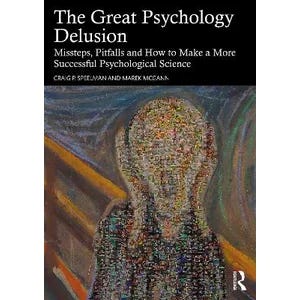
Find Marek and Craig’s book The Great Psychology Delusion here.
This is an academic psychology-focused episode with lecturer Marek McGann, whose work spans enactive cognitive science, embodiment, politics, feminist philosophy, and Science and Technology Studies. Andrea and Marek discuss his co-authored book The Great Psychology Delusion with Craig Speelman. McGann explains why “delusion” fits psychology’s persistence in treating long-critiqued assumptions as valid, especially the aggregation delusion: averaging group data and applying it to individuals despite human non-interchangeability and change over time, linked to the ergodic assumption and ergodic theorem conditions rarely met in human behavior. They discuss how averaging can create misleading “laws” (e.g., power law of learning), the research–practice gap in clinical work, psychology’s history and method-driven identity, and the need for disciplined, pluralistic, scale-aware science that better integrates perspectives and practitioner expertise.
00:00 Show Intro And Intro Marek
01:23 Book Thesis And Stakes
02:24 Aggregation Delusion Explained
03:54 Research Practice Gap
04:49 More Detailed Book Summary
07:47 Averaging Artifacts And Ergodicity
09:29 Careful Critique Not Anti Psychology
11:06 Warm Reorientation Sendoff
11:51 Conversation Begins
15:17 Why Call It Delusion
20:11 How Psychology Became Method Led
31:08 Aggregation Delusion Deep Dive
33:35 Ergodic Fallacy in Humans
35:21 Scale Slippage and Delusion
37:59 Research Practice Gap Explained
41:01 Clinician Code Switching
42:46 Many Scales of Mind
43:57 MRI Averaging Pitfalls
48:32 Method Silos and Identities
52:43 Care, Careers, and Canalization
55:27 GPS Model for Pluralism
01:00:33 Pluralism Not Relativism
01:02:58 Why Marek Cares
01:06:06 Psychology’s Moment of Change
01:06:56 Closing Thanks and Wrap
Marek McGann has been a lecturer in the Department of Psychology since 2005. His principal research is theoretical work on the enactive approach to cognitive science, which examines the mind more as something we do rather than something we have. This is also related to ecological approaches to psychology, which explore how behaviour and mental life can be examined by looking at what your head is in, rather than what is in your head. He also has a related interest in critical considerations of theory and scientific practice in psychology more broadly.
Marek co-convenes the ENSO Seminars, a series of online seminars with researchers from enactive and ecological cognitive science. If you want to go deeper into enactive cognitive science, this is a good place to start.
The paper Andrea mentions: Facing Life
Please rate and review with love.
YouTube, Facebook, Instagram, Threads
“Human beings are basically the least ergodic things in the known universe. We all individually change over time. We do things differently as individuals, and differently from context to context — let alone different people doing the same thing in different conditions.”
“We do one thing, think we’re doing something else, and don’t have the capacity to reflect and realize the sliding between scales. Assuming that research with samples and averages has given you insight into individuals and their individual behaviors — that’s a delusional thing.”
“You can be pluralistic and still be doing good science. You can be disciplined and scientific without thinking there’s a single objective truth you have to be aiming for. Being pluralistic is very, very different from the idea that anything goes. It is simply a recognition of multiplicity.”
— Marek McGann
SUMMARY TRANSCRIPT BELOW
FOR FULL TRANSCRIPT, SEE LOVEANDPHILOSOPHY.COM
Andrea Hiott: Hi Marek. Thanks for being on Love and Philosophy.
Marek McGann: Pleasure to be here. Thanks for inviting me on.
Andrea: I met you in Austria about six months ago. I realized we had a lot in common, and then you mentioned a new book — which is now out. I’m constantly thinking about research methods in cognitive neuroscience, so I’m really glad to find it. It’s called The Great Psychology Delusion. Do you want to introduce it?
Marek: Sure. This is work I’ve been doing with my colleague Craig Speelman at Edith Cowan University in Perth, Australia. The book brings together different strands around theory and practice in psychological research. Our first publication together, back around 2013, looked at the use of averages and the mean in psychological research — the limitations, the underlying assumptions. Nothing terribly new to most psychologists, and yet despite that, everyone still continues on as though everything’s fine, when we think it really isn’t. This book is an attempt to bring those threads together: the often-implicit assumptions about human beings that underlie psychological research, and the implications for how we understand, interpret, and apply the findings. We try to elucidate the underlying issues in a clear, and sometimes polemical, way.
Andrea: The word “delusion” is really strong. Why did you choose it?
Marek: It is perhaps a little hyperbolic, but it articulates something we both find particularly frustrating in the dialogue around these issues. We open with the Oxford dictionary definition: “an idiosyncratic belief or impression maintained despite being contradicted by reality or rational argument.” For so many of the points we address — the problematic use of averages, the weak and undisciplined way theoretical work is done — these have decades of criticism behind them. And yet mainstream psychological research just plows on as though all is well. We really want to call that out. The community, or a large chunk of it, seems to blindly follow established practice without a clear enough understanding of why those practices exist or what they actually produce. We have to see and name it as a delusion to crack open the shell of mainstream misconceptions.
Andrea: It seems like you’re trying to make us realize how general and disparate all of this is, so that we can be more specific. Does that make sense?
Marek: That’s a very nice, succinct way of putting it. Yes, absolutely.
Andrea: Psychology is probably one of the most popular subjects people study or want to be part of. And yet you’re showing that the fundamental ways we do it academically are deeply flawed. How do you see that contradiction?
Marek: There are a number of forces in play. One thing that underpins the whole book is that we draw on roughly forty years of work in the history and philosophy of science — work that makes it very clear that science is a deeply human endeavor. Once you apply that lens to psychology, you can trace how many of its threads are actually quite separate and never properly drawn together. Where they are combined, it’s often for political or pragmatic ends rather than genuine scientific coherence. From the late 1980s onward, there’s an analysis of psychology as a discipline defined not by the phenomena it studies, but by the set of methods it uses. To become a psychologist is to learn certain research methods, and the phenomena almost get pushed aside. We have a tendency to force our phenomena into certain ways of asking questions, rather than adapting our methods to suit the phenomena.
Andrea: I see the same pattern so often: what we care about most, we try to get rigorous about — and we end up going to the methods. Do you see a connection between science defending its methods to remain credible, and losing track of what it actually cares about?
Marek: Yes, that’s exactly the logic we’re looking at. As a discipline, we’ve decided that certain ways of constructing phenomena are the only valid ones, and everything else gets relegated to the messy outside — the domain of practitioners, not hardcore science. The general assumption is that when physicists bring things into the lab, it’s to stabilize an otherwise dynamic phenomenon. Psychology applied the same logic, except we didn’t bring something in from the real world — we created it. Our notions of reasoning, decision-making, and problem-solving are largely drawn from philosophical analyses of how people should think, not from systematic observation of what people actually do.
Andrea: Could you walk through the aggregation delusion specifically — the individual-versus-group confusion?
Marek: This was the foundational issue where Craig’s and my work began. It’s the assumption that human beings are sufficiently interchangeable — that you can gather a large group, produce data, average across it, and “boil off the noise,” ever-approximating a truer measurement of some psychological variable. But to do that, you have to assume we’re all essentially doing the same thing. This is sometimes called the ergodic assumption: that the average of the group is sufficiently similar to the average of the individual, so that studying the group gives you insight into individuals. That’s fine for hydrogen atoms. But human beings are basically the least ergodic things in the known universe. We each change over time. We do things differently from context to context, let alone different people doing the same thing in different conditions.
The notion that aggregating scores approximates a true score — which underlies almost all tests of mean difference, which are fundamental to the vast majority of laboratory psychological work — is an untenable assumption that goes almost entirely unquestioned. It misrepresents phenomena at two different scales: the behavior of a sample, and the behavior of an individual. Psychologists will say they’re interested in understanding the mind, which occurs one per person. But in a large amount of our research, we don’t look at individuals at all. We only look at samples and their averages. Not being able to see that mismatch is the delusion.
Andrea: And yet you also say we do get a lot from group-level study. What would it look like to open that up and become more specific?
Marek: A lot is being covered by individual professional sensitivity, particularly in clinical psychology and counseling. There’s what’s called the research-practice gap, and it means different things to different people. For researchers, the gap is that practitioners aren’t implementing findings as prescribed. For clinicians, the gap is that the research simply doesn’t fit their needs — because research uses carefully selected, clean samples that individual cases almost never resemble.
Insofar as a practitioner takes research insights and applies them effectively, the sensitivity and responsiveness of that clinician to their individual client is doing a huge amount of the heavy lifting. There’s a lovely observation from Sanneke de Haan in Enactive Psychiatry: psychiatrists tend to code-switch between conferences and clinical settings. In conferences, they talk about the brain constantly. In the hospital, they speak in the language of clients — experience, behavior, concrete realities. The clinicians often aren’t aware of that switch. If we can just recognize that these movements are happening, we can reflect on them and orient ourselves more effectively. The issue is not that one scale is wrong and one is right, but that you should know when you’re moving between them and what changes when you do.
Andrea: When you bring up pluralism, doesn’t it also happen at other scales — in our lives, in the way we can return to a motivating force that isn’t hurting us?
Marek: Yes. We get channelized — canalized, as it’s sometimes described neurologically. I’ve become this type of researcher. I’ve adopted this set of methods. I can build a career with it. If I step outside, I weaken my position. There’s nothing pulling me back. But I think it’s all ultimately motivated by care. Most psychologists got into this because some aspect of human experience was close to home, often personal.
An example I love: the GPS system is an engineering achievement, but it depends on satellites launched using Newtonian physics, carrying atomic clocks that only work because of quantum mechanics, using Einsteinian relativistic mathematics to identify coordinates on a round globe, represented on a flat-earth map for a human navigating a street. All of those perspectives are mutually exclusive descriptions of the universe — you can’t be Einsteinian and Newtonian simultaneously, or Newtonian and quantum. And yet the GPS system works brilliantly. It is all of those things at once, embedded in a collection of human practices that makes it all make sense without worrying about the mismatches. That kind of pluralism can be immensely productive. The messiness of psychology isn’t the problem. It’s the way we conflate mess with reductionism — insisting a concept developed at one scale must mean the same thing at another. What we need is to get comfortable in the tension of pluralism, and to build in deliberate, little habits of silo-breaking: go listen to the qualitative people for a while, go listen to the cognitive people. Help each other hold the tension.
Andrea: And it’s not “anything goes” either — which is maybe why it’s so tense. Is there anything you want to add?
Marek: No, I fully endorse that. The fear for so many scientists is that the value of science lies in there being a single objective truth we can aspire to. But scientists are actually very capable of holding multiple truths in mind at once and being fine with it. You can be pluralistic and still be doing good science. You can be disciplined and scientific without thinking there’s a single objective truth you’re aiming for. Being pluralistic is very different from relativism. It is simply a recognition of multiplicity.
Andrea: Why do you care about this, Marek?
Marek: My undergraduate degree is in psychology. I’ve always had a philosophical bent, and my early postgraduate work was in philosophical psychology. I then expanded into cognitive science, did a master’s, and a doctorate at the University of Sussex with a group of enactive thinkers. Throughout all of that, I was teaching a module on critical issues in psychology, which suited my philosophical leaning and gradually became a significant part of my work. Those two strands — philosophy and cognitive science on one side, conceptual and historical issues in psychological science on the other — coalesced over the past decade and a half into papers with Craig, and ultimately this book.
Andrea: You really do care about psychology as a discipline.
Marek: I really do. For a lot of psychologists, I’m not a psychologist — I don’t do enough empirical work for their tastes, I get dismissed as a philosopher. But I consider myself a psychologist. I’m paid by a department of psychology. And psychology is going through an unusual period of vigor around these discussions. There is a real possibility for transformation and for an increasingly successful psychological science, if we can just work through some of these supposedly philosophical questions.
Andrea: Well, you’ve been holding that tension — and that’s a real service. Thanks for the book, and thanks for being here.
Marek: Thanks so much for having me. Great to see you.


